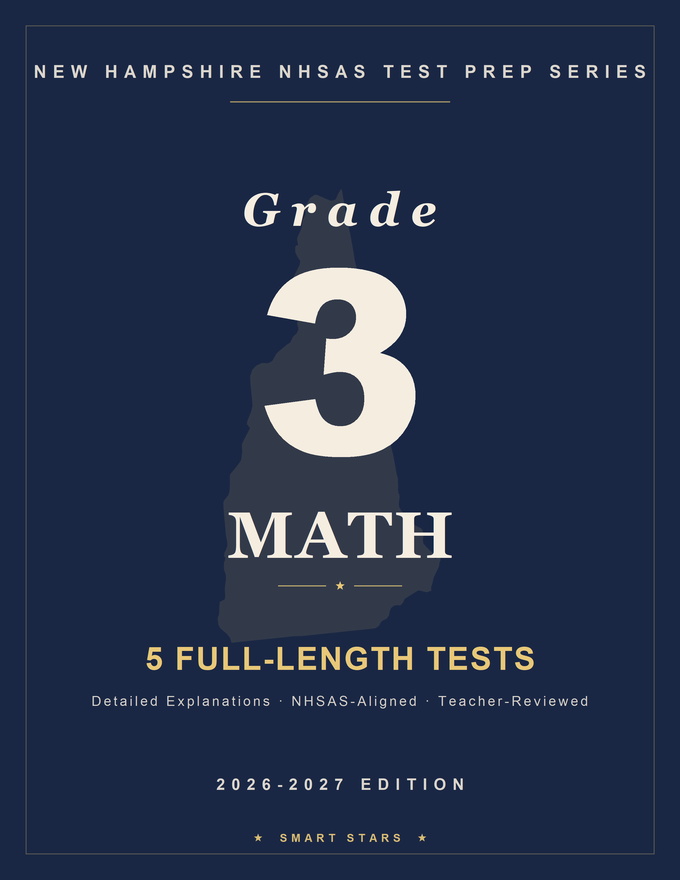
Give your third grader the confidence to succeed on the New Hampshire NH SAS Grade 3 Math test.
This Smart Stars book provides five full-length, standards-aligned tests that mirror the length, item mix, and question types of the real NH SAS spring assessment in Mathematics. Every question was written by experienced educators, reviewed for accuracy, and built around the New Hampshire College and Career Ready Standards for Mathematics at Grade 3 (which at Grade 3 are the Common Core State Standards) so the topics and emphasis match what New Hampshire students actually see.
NH SAS (the New Hampshire Statewide Assessment System) is the test the New Hampshire Department of Education gives to every public-school student in Grades 3-8 (and the third year of high school). It is delivered by Cambium Assessment as an untimed, computer-adaptive test, with paper forms available as an accommodation. The spring administration is the one that counts toward grade-level results. The Grade 3 math test uses no calculator, and it blends single-answer multiple choice with multiple-select (“select all that apply”), type-in answers, comparison matching (greater-than, less-than, equal-to), and interactive number-line, graph, and area-model tasks. On the test a student answers about 34 scored questions, with several unscored field-test questions mixed in invisibly. Each test here follows that same shape: 34 scored-style questions plus 8 field-test-style questions, 42 in all, for 210 questions across the book: to build true test-day endurance.
What’s inside
- Five full-length tests, with detailed Answers and Explanations after every test
- Coverage of every Grade 3 math area NH SAS reports (Operations & Algebraic Thinking, Number & Operations (Base Ten and Fractions), and Measurement & Data & Geometry) weighted toward the Operations and Number work (multiplication and division and fractions) that carries the most questions, just like the real blueprint
- Field-test-style questions blended invisibly into each test, just like the real NH SAS, and fully answered here so nothing on test day feels unfamiliar
- Practice in every NH SAS item format rendered for paper: multiple choice, multiple select (“select all that apply”), type-in/fill-in answers, comparison (>, <, =) matching, two-part and sentence-completion items, number lines, line plots, area models, bar and picture graphs, and figure-based geometry
- Every explanation walks through the reasoning step by step and ends with a labeled Tip, Check, or Estimate (with a Strategy on the multi-step questions), so students learn the move, not just the answer
- A combined Quick Answer Key after each test for fast self-grading
- A family letter, a test-taking tips section, and a Grade 3 math study reference page up front: included as a study aid, since the real NH SAS is taken on a computer with its own on-screen tools
- No-calculator practice throughout, matching the official NH SAS Grade 3 policy
No calculator. The real Grade 3 test is given on a computer with on-screen tools and no calculator, so students here practice exactly as they will test: with only pencil, paper, and what they have learned. An inch ruler is helpful for the measurement and line-plot questions.
Topics covered
- Rounding whole numbers to the nearest ten and hundred, and place-value reasoning within 1,000
- Adding and subtracting whole numbers within 1,000, with and without regrouping, and missing-number problems
- Understanding multiplication and division through arrays, equal groups, repeated addition, and number lines, and the way multiplication and division undo each other
- “Times as many” multiplicative comparison, properties of operations, and multiplying one-digit numbers by multiples of ten
- Two-step word problems using the four operations, and identifying and extending number patterns
- Fractions as numbers: unit fractions, fractions of a whole and of a set, fractions on a number line, equivalent fractions, whole numbers written as fractions, and comparing and ordering fractions with the same numerator or the same denominator (halves, thirds, fourths, sixths, and eighths)
- Sorting and classifying quadrilaterals (squares, rectangles, rhombuses, and trapezoids) and partitioning shapes into equal parts
- Perimeter of polygons, including finding an unknown side and composite figures
- Area of a rectangle by tiling with unit squares and by multiplying side lengths, including composite figures
- Measuring length to the nearest half inch and quarter inch
- Telling and writing time to the minute, and finding elapsed time
- Reading and building scaled picture graphs and bar graphs, and line plots marked in halves and quarters
- Analyzing data to answer “how many more,” combine-and-compare, and two-part questions
Why parents and teachers choose Smart Stars
- Educator-authored. Every question is written and reviewed by classroom-experienced educators.
- Mirrors test day. Each test matches the official NH SAS shape, item mix, question formats, and no-calculator policy, with field-test questions blended in invisibly just like the real test.
- Built for New Hampshire. Aligned to the New Hampshire College and Career Ready Standards for Mathematics at Grade 3 (which at Grade 3 are the Common Core State Standards) with grade-appropriate real-world contexts and a diverse cast of student names.
- Explanations teach the why. Every Answers and Explanations entry shows the full worked solution, then a labeled closing Tip, Check, or Estimate (and a Strategy on multi-step problems) so students learn the reasoning.
- Varied and graduated. Slot positions, contexts, names, and number choices rotate test-to-test, and the five tests step up in difficulty: the later tests lean on more multi-step, multi-select, and two-part reasoning: so no two feel like the same run.