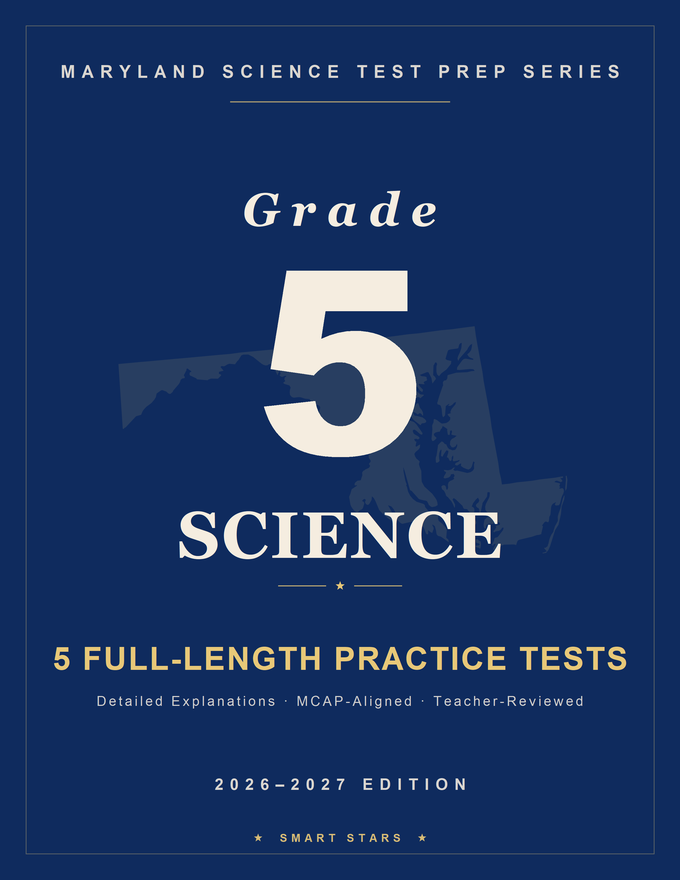
Give your fifth grader the confidence to succeed on the Maryland Integrated Science Assessment (MISA), the science test of the Maryland Comprehensive Assessment Program (MCAP).
This book contains five full-length practice tests — 240 questions total — aligned to the Maryland Next Generation Science Standards. The fact that surprises Maryland families most is the one this book is built around: the Grade 5 MISA is not a test of Grade 5 science alone. It draws on the standards for grades 3, 4 and 5 together — 42 performance expectations, of which only 13 belong to grade 5. A student who reviews only this year’s science has prepared for less than a third of the test. Every explanation here names the grade whose standard the question tests.
What’s inside
- 5 complete 48-question practice tests (240 questions total), each worth 67 points
- Built in four 40-minute sessions with two question sets per session — the shape of the real MISA
- Every set opens with a storyline — an investigation, a place, a table, a drawing or a map — then asks five selected-response questions and one written response about it
- Multiple-choice, multi-select, and two-part questions where Part B asks for the evidence behind Part A
- 40 written responses worth 2, 3 or 4 points, each with a full-credit and a partial-credit sample answer and a scorer’s note
- Maryland’s holistic scoring rubrics printed in the book, before the Quick Answer Key
- Detailed explanations for every question — not just the correct letter, but step-by-step reasoning
- Every answer labeled with its standard, reporting category, grade and skill
- Matched to both of Maryland’s reporting schemes at once: science domain, and science and engineering practice
- 84 drawings and 26 data tables, so students read figures the way the real test asks them to
- A parent letter with test-taking tips, plus a Grade 5 Science Study Reference covering all three years
- A quick-reference answer key for all five tests
Topics covered
- Weather patterns and climates, daylight and shadows, the sun and other stars
- Rock layers and fossils, weathering and erosion, and reading maps
- Earth’s four interacting systems, where Earth’s water is, and natural hazards
- Life cycles, group behavior, habitats, and variation and survival
- Inherited traits and traits shaped by the environment
- Structures plants and animals use to survive; senses and the brain
- How plants build themselves from air and water; matter moving through food webs
- Balanced and unbalanced forces, patterns of motion, magnets, and gravity
- Speed and energy, collisions, and devices that change energy from one form to another
- Energy moving as sound, light, heat and electric current; waves and how we see
- Particles too small to see, weight before and after a change, and identifying materials
Why parents and teachers choose Smart Stars
- Written by educators who study Maryland’s official MISA blueprint, rubrics and released items
- Every question mirrors what students will see on test day — no surprises in format, content, or rigor
- Explanations teach the “why,” not just the “what,” so students learn from every mistake
- Built across grades 3, 4 and 5 — the span the real Grade 5 MISA actually draws from
How to use this book
Take one test at a time in a quiet space, in four 40-minute sessions, as on test day. Maryland gives no reference sheet during the Grade 5 science test, so use the Study Reference before a sitting rather than during one. Score with the quick answer key, then review every explanation, even for questions answered correctly. Space the five tests over several weeks. This book is built for the spring 2027 MISA.