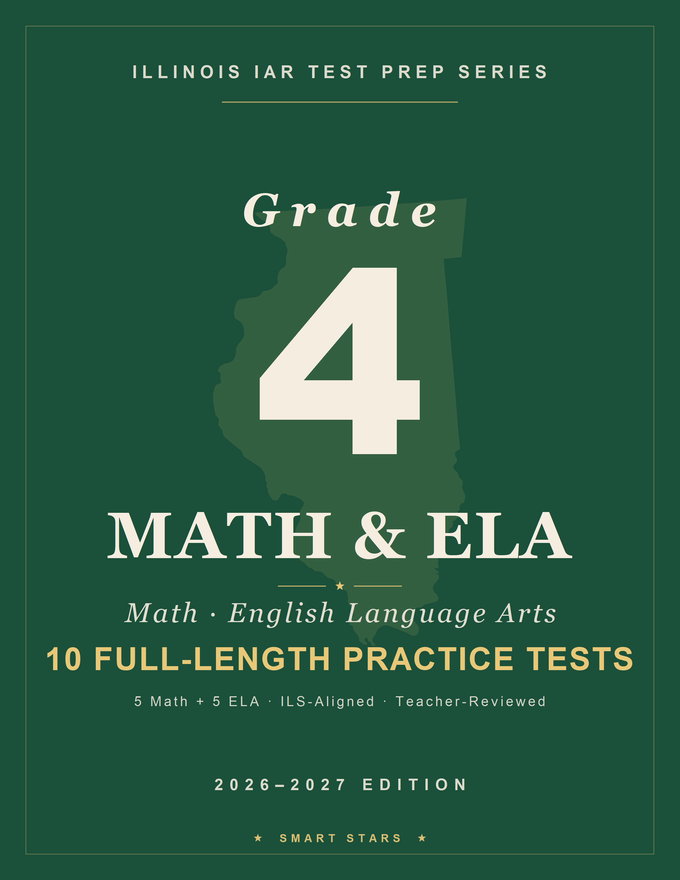
Give your fourth grader the confidence to succeed on both Illinois Assessment of Readiness (IAR) tests — Mathematics and English Language Arts — in one book.
This combined edition brings together ten full-length practice tests — five in Mathematics and five in English Language Arts, 440 questions in all — aligned to the Illinois Learning Standards and designed to match the format, difficulty, and content of the real Grade 4 IAR.
Take a look inside
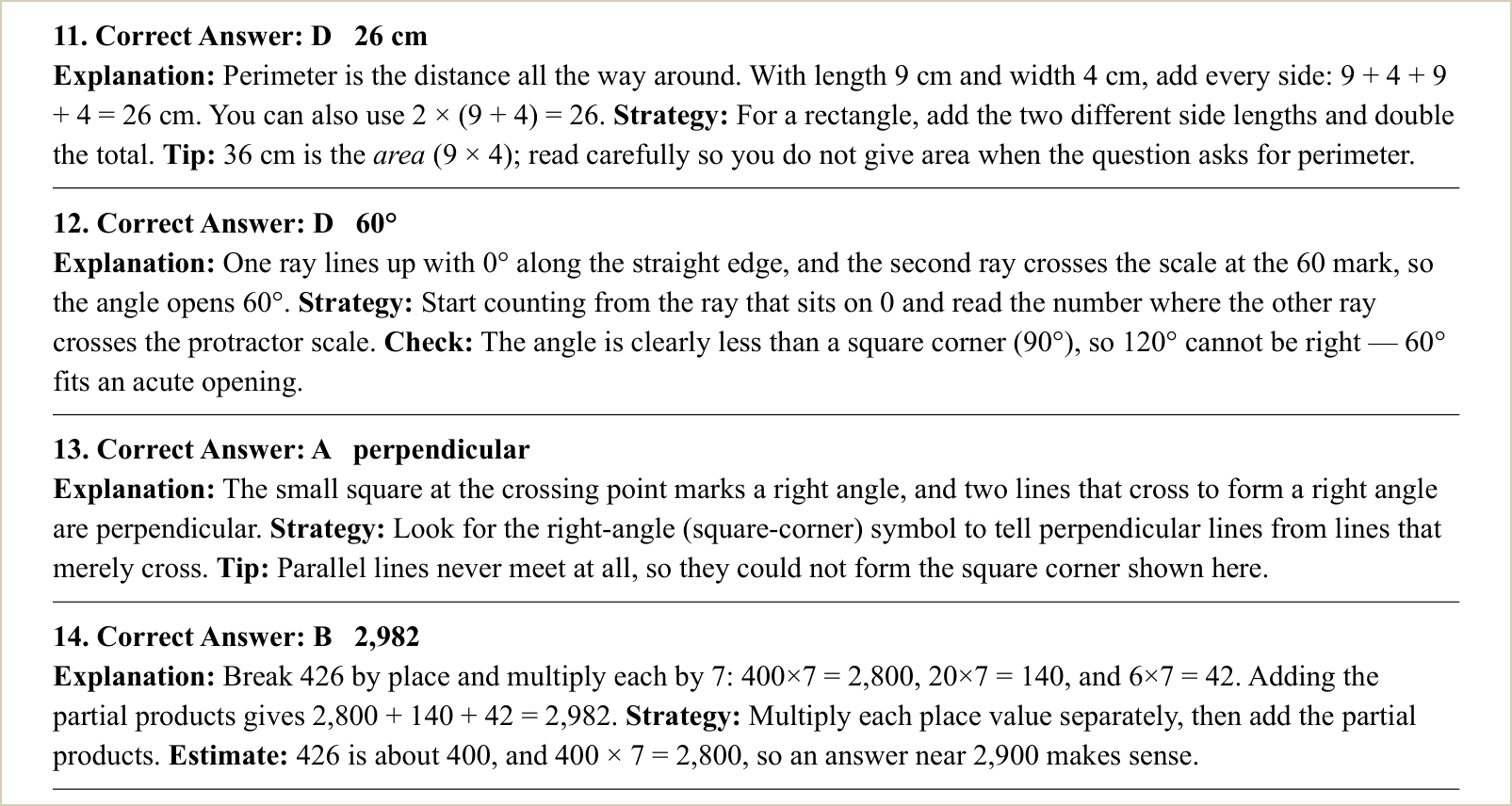
- Delivery: the IAR is given each spring to every public-school student in Grades 3–8, overseen by the Illinois State Board of Education and delivered online by Pearson.
- Item bank: IAR descends from the earlier PARCC test, so its reading-and-writing tasks share that lineage.
The two halves of the book are the same practice tests offered in our two individual Grade 4 titles; if you already own both, this edition does not add new tests.
On test day: the IAR is untimed (Illinois suggests a time for each unit but sets no hard clock on a student’s work), and Grade 4 Mathematics allows only pencil and scratch paper.
What’s inside
- 5 complete Mathematics practice tests, 50 questions each, organized into three units exactly as the real test is — a full form worth 83 points, the score total Illinois fixes at Grade 4
- 5 complete English Language Arts practice tests, 38 questions each, each given in two units the way the real test is: Unit 1 a Literary Analysis Task built on two related stories, Unit 2 a Research Simulation Task built on a set of sources — with one written response in each unit
- Mathematics built from the three kinds of question the real form uses, in the same balance: skills-and-procedures questions (most worth 1 point), reasoning questions that ask why an answer is correct or where an error lies (3–4 points), and modeling questions — longer real-world problems that ask students to show all their work (3 or 6 points)
- Every IAR item format rendered for paper: four-option multiple choice, multiple select, fill-in-the-blank, two-part Part A / Part B evidence questions, table and sorting items, and longer open-response questions — across both subjects
- Genuine multi-source research sets in ELA: three sources on one subject, with questions that require reading across them rather than inside just one
- Literary passages that include a poem and a short play, so students meet drama and verse before test day rather than on it
- Both essays come with a sample top-score answer and the printed scoring rubric, so a parent can score writing with confidence
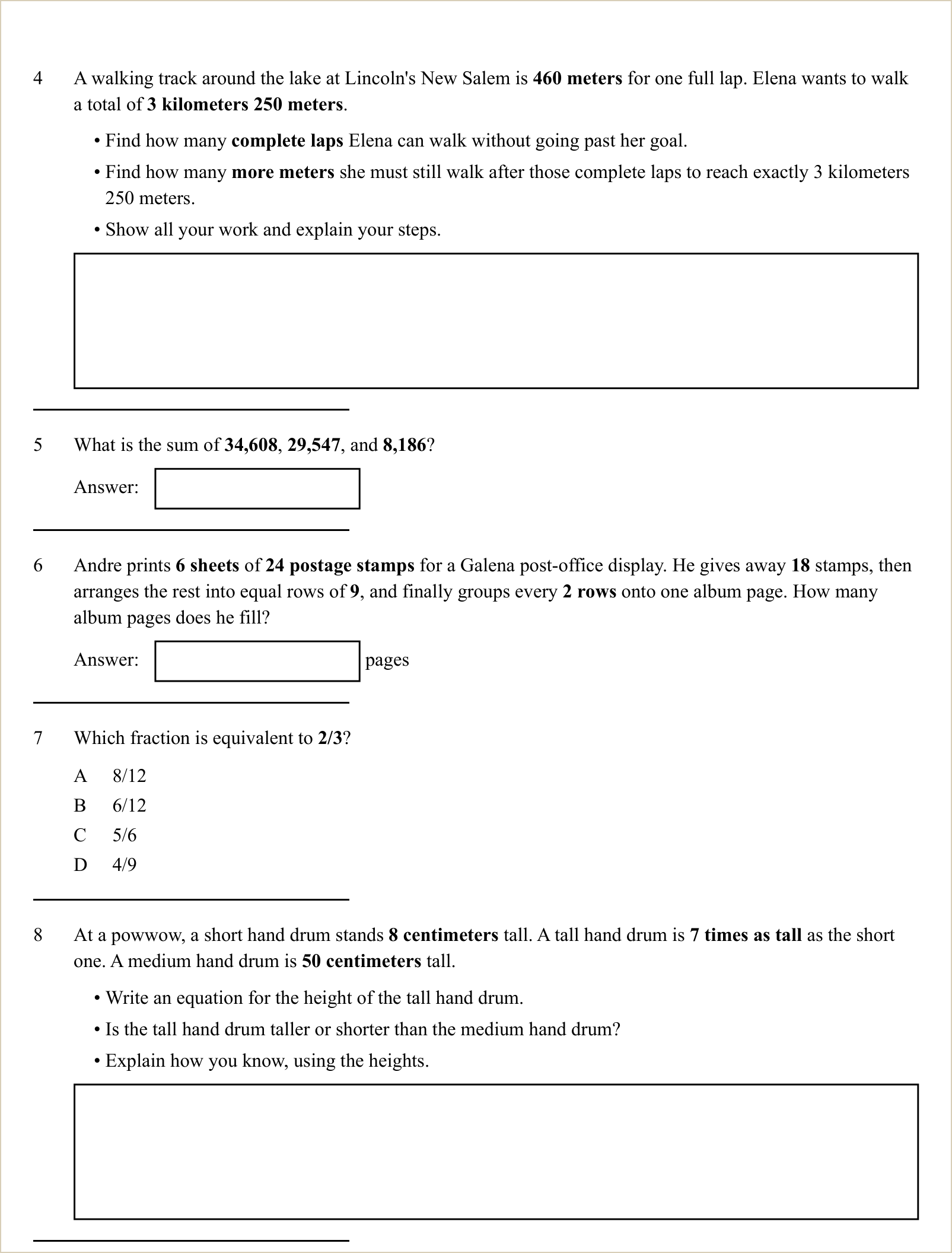
- Detailed answer explanations for every question in both subjects — not just the correct answer, but the text evidence, the worked reasoning, and the misreading that makes a wrong answer tempting
- A Grade 4 Math Study Reference and a Grade 4 ELA Study Reference, each for use while studying — the book says plainly that neither is available on the real test
- Separate Quick Answer Keys for Mathematics and for English Language Arts, for fast scoring
- Balanced ELA practice across all five reporting categories, at roughly the real test’s 60% reading / 40% writing split
Topics covered
- Place value to one million, comparing and rounding multi-digit numbers
- Multi-digit multiplication and long division, using partial products and partial quotients
- Fractions: equivalence, comparison, addition and subtraction, and multiplying a fraction by a whole number
- Decimals to hundredths, and the link between fractions and decimals
- Factors, multiples, and prime and composite numbers
- Number and shape patterns, including two-rule patterns
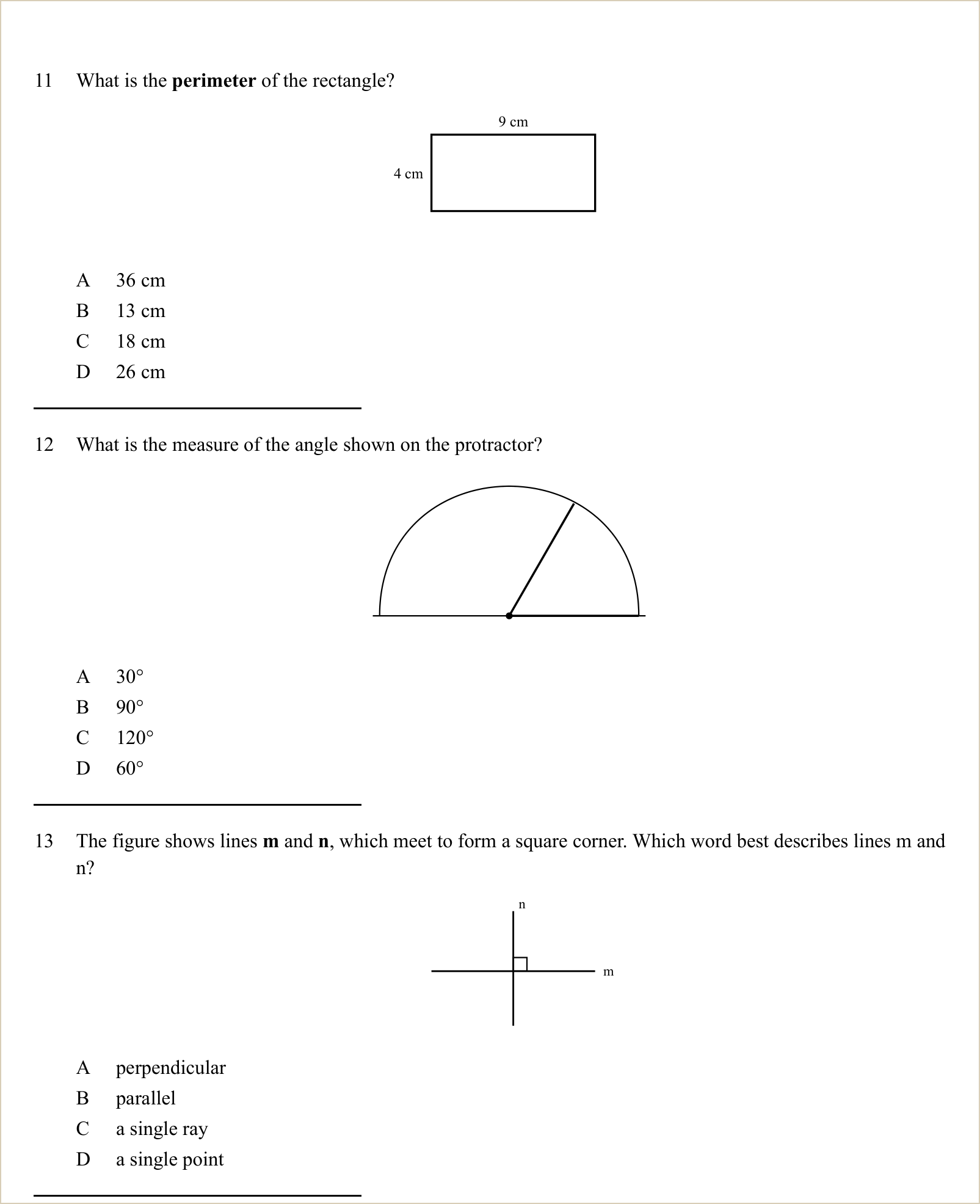
- Area, perimeter, and measurement conversion within a system
- Angles and the protractor, including finding an unknown angle by addition and subtraction
- Lines, rays, symmetry, and classifying two-dimensional figures
- Line plots with fractional measurements
Topics covered — English Language Arts
- Realistic stories about patience and generosity — a sourdough starter, a chess match, a pond race, a class presentation, a long line at dawn
- Geocaching, and finding a cache with GPS
- Tardigrades — the toughest animal you have never seen — and how to find one
- Why steel ships float, and what displacement really means
- Mail-order catalogs, and how an order traveled from a farm kitchen to Chicago and back
- How a library shelves fifty thousand books so any one can be found
- Rail-trails, and how a railroad grade becomes a bike path
- City parks, and the arguments made for and against open land
- Cahokia and three kinds of ancient mounds
- Early photography, and why nobody smiles in old photos
- Vocabulary in context, main idea, text structure, cause and effect, author’s purpose, and integrating information from several sources
Why parents and teachers choose Smart Stars
- Written by experienced educators who study Illinois’s official IAR specifications, evidence statements, and released item samplers
- Every question mirrors what students will see on test day — no surprises in format, content, or rigor
- Explanations teach the “why,” not just the “what,” so students learn from every mistake
- Passages, characters, numbers, and question types varied across all ten tests
- Both subjects in one volume, at a lower price than the two individual titles bought separately