About this book
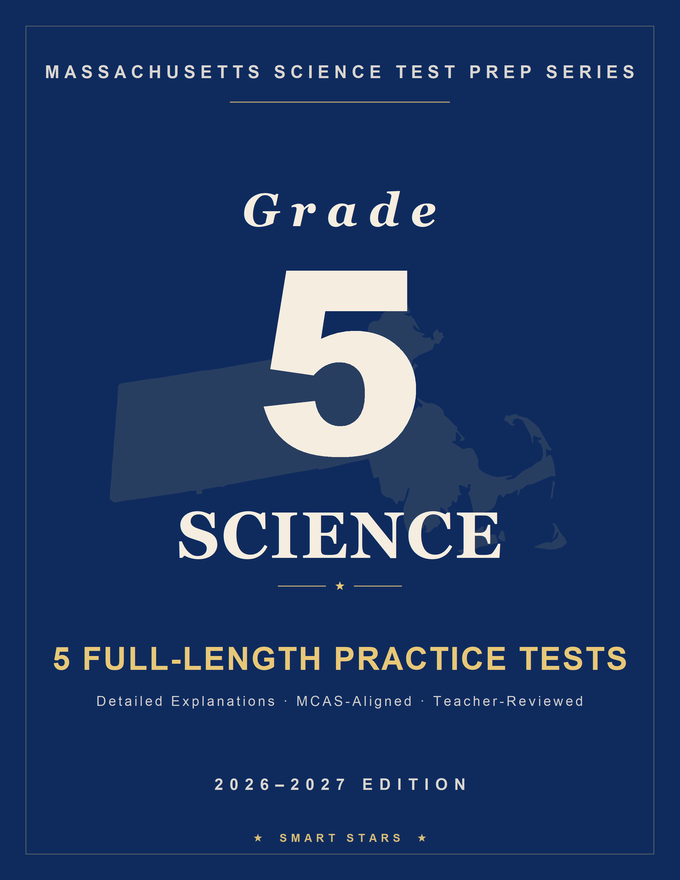
Give your fifth grader the confidence to succeed on the Massachusetts Comprehensive Assessment System (MCAS) Grade 5 Science and Technology/Engineering test.
This book contains five full-length practice tests — 200 questions total — aligned to the 2016 Massachusetts Science and Technology/Engineering Curriculum Framework and built to the test’s new performance-task design taking effect in spring 2027.
Take a look inside
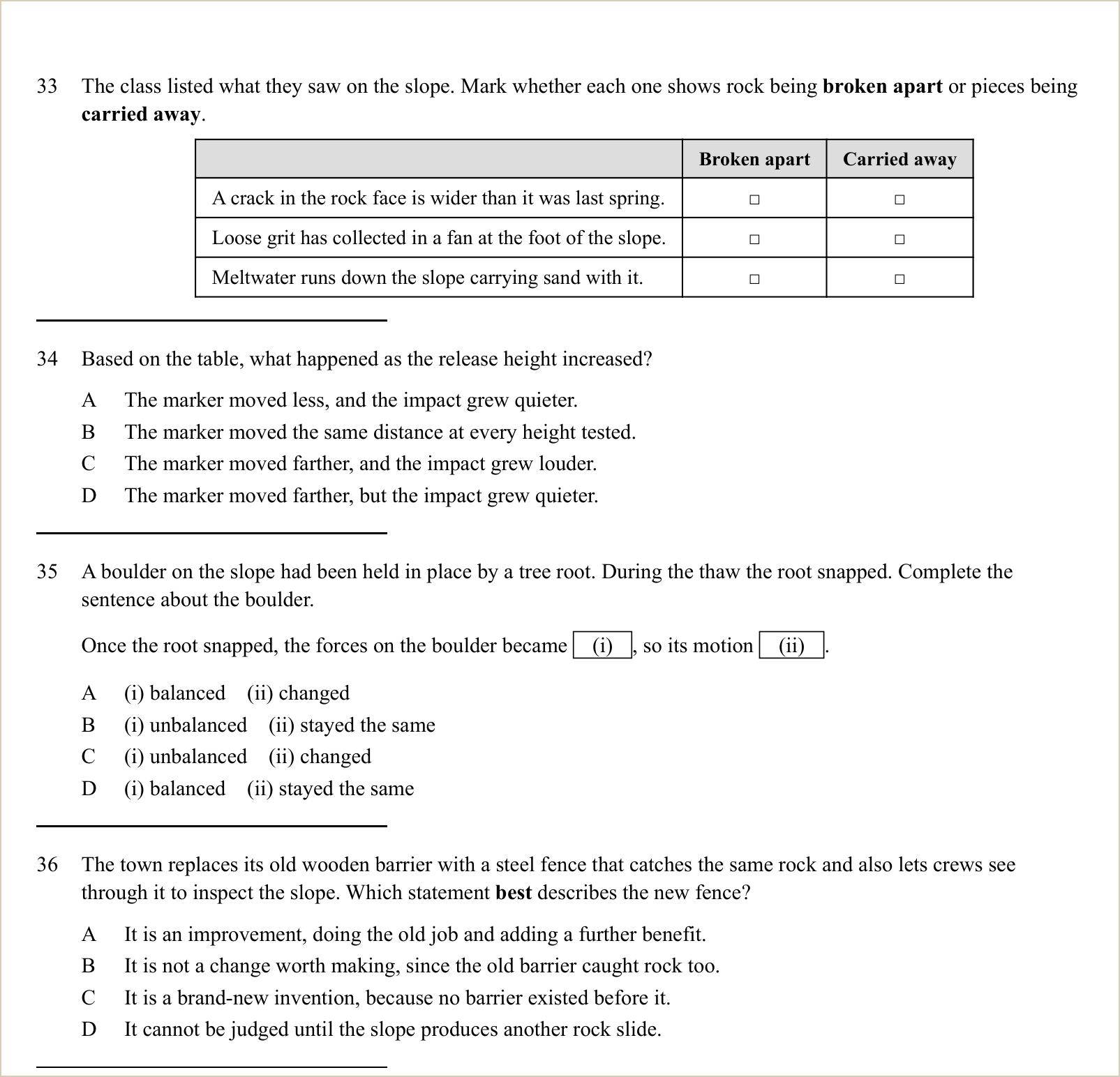
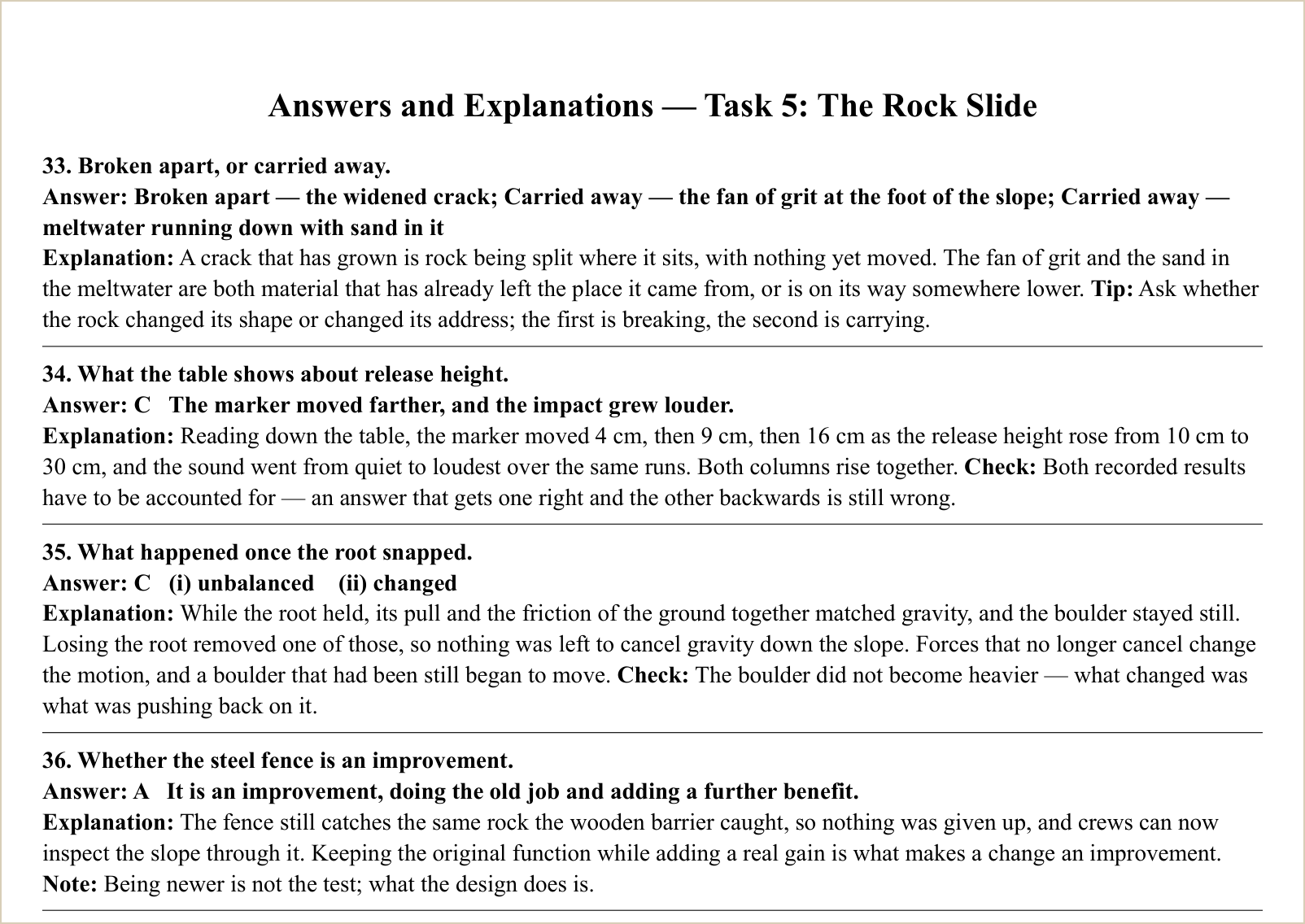
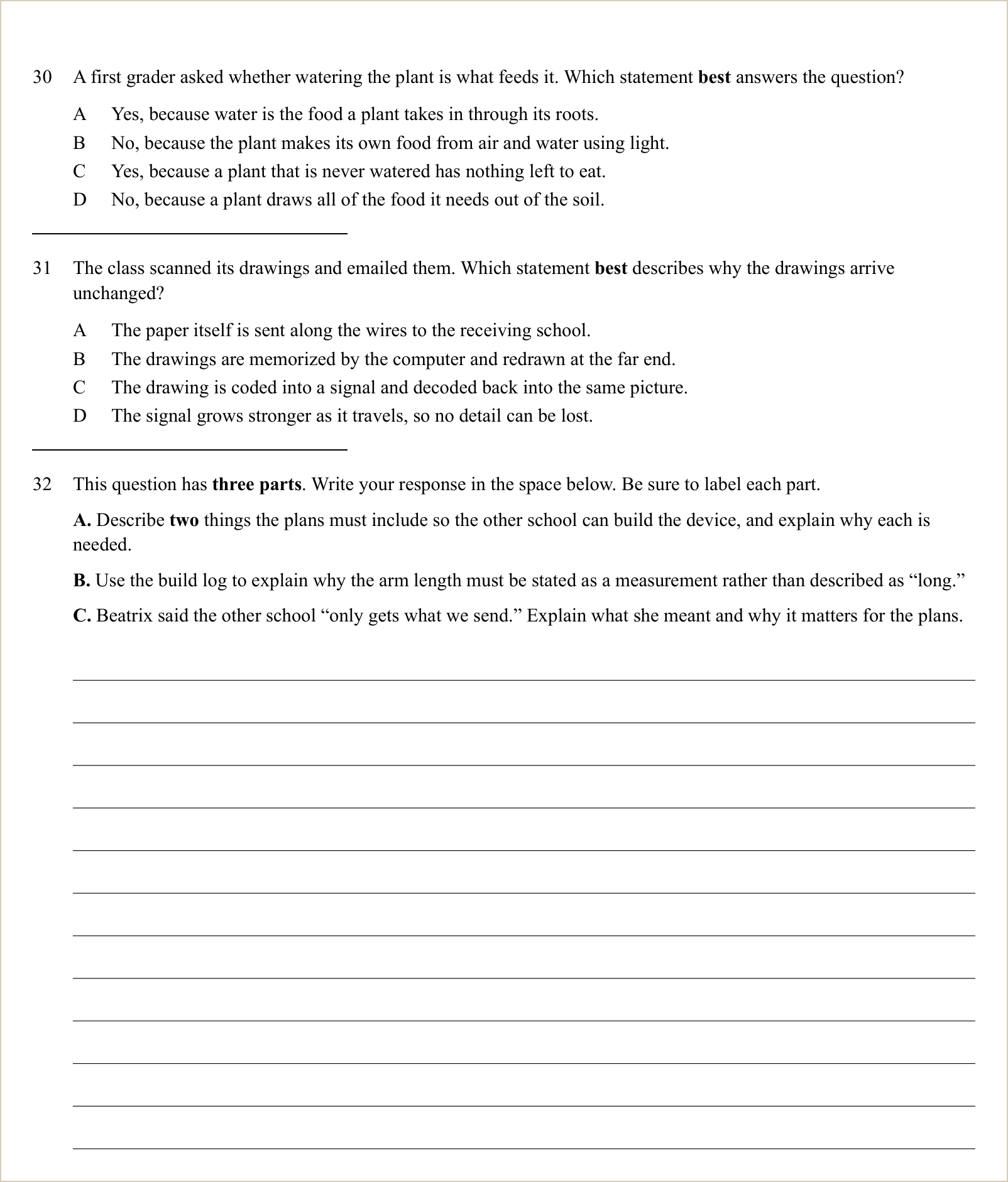
- Format: beginning in 2027, Grade 5 STE is no longer a list of separate questions; it is built from performance tasks, each one opening with an illustrated storyline about students investigating something real, and every question in that task follows from it.
- Length: a task carries eight questions worth eleven points — six worth one point, one worth two, and a written response worth three.
- On the real test: students meet six tasks across two sessions, and five of those six count toward the score, for 55 points in total.
- Field-test items: the sixth is a matrix task, whose questions look exactly like the others but do not count toward your child’s score.
- Each practice test here: the five scored tasks — 40 questions and the full 55 points.
So a practice sitting matches the scored length of test day and no practice time is spent on questions that would not have counted.
What’s inside
- 5 complete 40-question practice tests (200 questions total), each worth the full 55 points
- Built the way the 2027 test is actually built — from performance tasks, where an illustrated storyline and its data come first and every question in the task depends on them
- The written response is the anchor of each task, not an afterthought: every task ends with a 3-point constructed response, and the seven questions before it lead into it
- Every constructed response is scored with a printed rubric and a sample top-score answer, so a parent can grade a written answer with confidence
- Detailed answer explanations for every question — not just the correct letter, but the reasoning that builds real understanding
- The item types students actually meet inside a task: multiple choice, complete-the-sentence, table-match with a box to mark in each row, complete-the-model from a word bank, two-part questions where the second part asks for the reason behind the first, and one written response per task
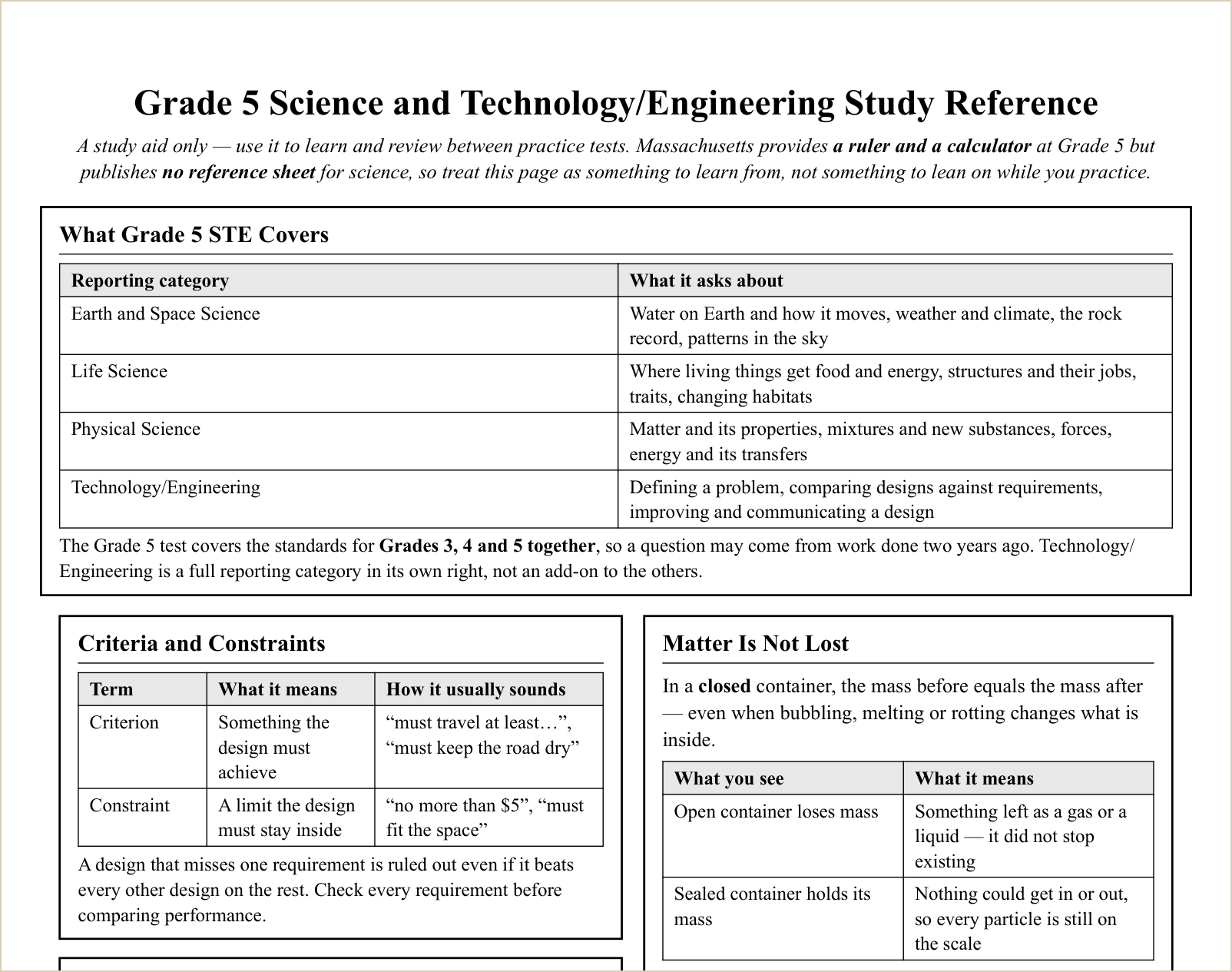
- Reporting categories balanced across every test — Earth and Space Science, Life Science, Physical Science, and Technology/Engineering, ten questions each, every test
- Names, settings, numbers, and figures varied across all five tests, so students never meet the same problem twice
- A parent letter with test-taking tips, plus a Grade 5 Science and Technology/Engineering Study Reference for use while studying — Massachusetts does not publish a reference sheet for Grade 5 science, and the book says so plainly rather than implying one will be there
- A quick-reference answer key for all five tests for fast scoring
Topics covered
- Forces and motion, including balanced and unbalanced forces and reading the size of a force from what it changed
- Gravity, and the direction it acts on a ramp, a stand, and falling water
- Stored energy becoming motion, and the energy carried into a collision
- Energy transfer through a lever, a turbine, a battery, and a motor
- Waves, wave energy, and amplitude
- Light: its path, reflection, how it behaves in water and on snow, and why an object is visible
- Sound, and the material it needs in order to travel
- Properties of matter, identifying a material by its properties, and telling similar powders apart
- Conservation of matter in open and closed containers, including melting and evaporation
- Evidence that a new substance has formed, and ruling out a rival explanation
- Mixtures and solutions, including salt water and the limits of filtering
- Plants, what they need, and where leaf material actually comes from
- Structure and function in seeds, roots, leaves, and animal structures
- Food webs, decomposers, and matter moving through an ecosystem
- Inherited traits, variation among offspring, and traits shaped by conditions
- Habitats, seasonal response, and what a change in habitat costs
- Earth’s water: where fresh water sits, how it is stored, and how it moves through a marsh, a dam, and a snowpack
- Weather and climate, comparing places and reading a climate record
- Weathering, erosion, and deposition, and reading an erosion record over time
- Rock layers and fossils as a record of past environments
- Patterns in the sky: the sun as a nearby star, apparent versus actual brightness, and the moon’s pattern
- Human impact, runoff, protecting a pond, and choosing an energy resource
- Defining a problem, telling a criterion from a constraint, comparing competing designs, testing and improving a design, and communicating it
Why parents and teachers choose Smart Stars
- Written by experienced educators who study the state’s official Grade 5 STE framework and the published design of the 2027 test
- Every question mirrors the format and rigor students will meet on test day — no surprises
- Explanations teach the “why,” not just the “what,” so students learn from every mistake
- Contexts and figures varied across the five tests — every question feels fresh
- Built to the real performance-task architecture, including the storyline-first stimulus and the written response that closes every task — the features students most often meet for the first time on test day
- Where Massachusetts has not yet published a detail — session timings, or the scores that mark each performance level, which cannot exist before the first operational year — this book says so rather than inventing it