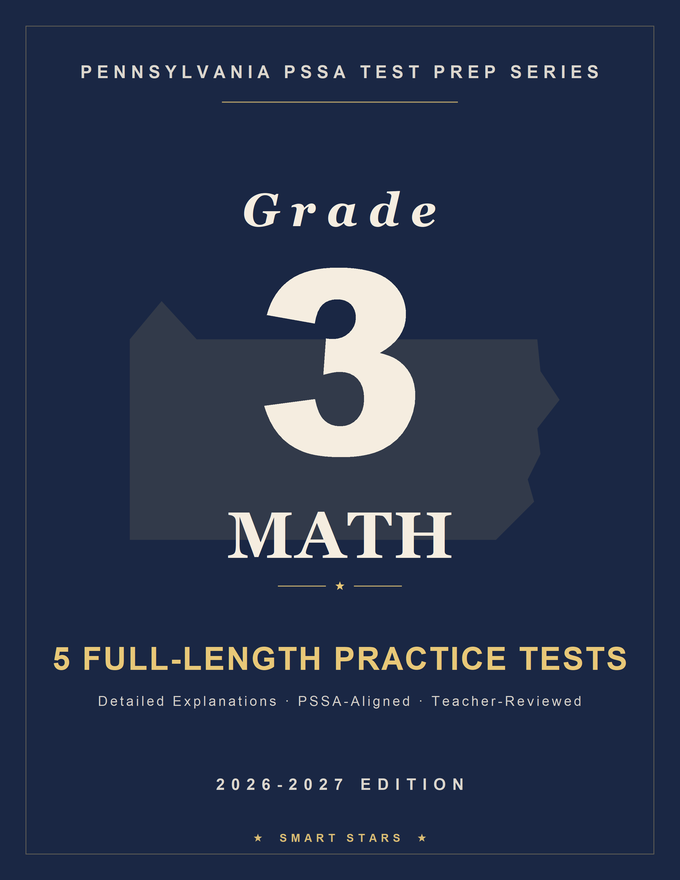
Give your third grader the confidence to succeed on the Pennsylvania System of School Assessment (PSSA) Mathematics test.
This book contains five full-length practice tests (215 questions total) aligned to PA Core Mathematics and the Pennsylvania Department of Education’s Assessment Anchors and Eligible Content (M03) for Grade 3 and designed to match the format, difficulty, and content of the real Grade 3 PSSA Math exam. (This includes the open-ended constructed-response items and technology-enhanced item types that appear on the actual PSSA exam, so each practice test mirrors the true 43-item count and helps your child build real-world test “endurance” for the full sitting.)
What’s inside
- 5 complete 43-question practice tests (215 questions total)
- Two-section format that mirrors test day: Section 1 (Questions 1:26) and Section 2 (Questions 27:43), with a STOP marker between the sections exactly as on the real PSSA, and no calculator on any item
- 40 multiple-choice and technology-enhanced items plus 3 open-ended questions per test: each open-ended item is divided into four sub-parts worth 1 point each, scored with the full PSSA scoring guidelines
- Detailed answer explanations for every question: not just the correct letter, but step-by-step reasoning that builds real understanding, plus model student responses and partial-credit guidance for every open-ended item
- Item types, names, and contexts varied across all 5 tests, so students never see the same problem twice in the same slot
- Reporting categories grouped exactly as on the official test: Numbers and Operations in Base Ten (M03.A-T), Numbers and Operations: Fractions (M03.A-F), Operations and Algebraic Thinking (M03.B-O), Geometry (M03.C-G), and Measurement and Data (M03.D-M)
- A parent letter with test-taking tips and a guide to scoring open-ended items at home
- A quick-reference answer key for all five tests for fast scoring
How to use this book: Take one test at a time under realistic conditions (about 75:90 minutes per section in a quiet space). Have only paper, pencil, and scratch paper at hand (no calculator on Grade 3 PSSA Math. Pause briefly at the STOP marker after Question 26, then continue with Section 2. Score the test with the quick answer key, then review every explanation) even for questions answered correctly. For each open-ended item, compare your child’s response to the model response and use the rubric to award partial credit. Space the five tests over several weeks for the best results.
Topics covered
- Place value through 10,000: reading, writing, comparing, and ordering whole numbers
- Rounding whole numbers to the nearest 10 and nearest 100
- Multiplying one-digit whole numbers by multiples of 10 within 100
- Multiplication facts through 10 × 10 with automaticity
- Division within 50 (dividends through 50, divisors and quotients through 10)
- Properties of operations: commutative, associative, and distributive
- Solving for the unknown in multiplication and division equations
- Identifying multiples of a one-digit whole number
- Two-step word problems using all four operations
- Arithmetic patterns from addition and multiplication tables
- Fractions on a number line, including whole numbers as fractions
- Equivalent fractions using visual models and number lines
- Comparing fractions with the same numerator or the same denominator (denominators 2, 3, 4, 6, and 8)
- Identifying and comparing two-dimensional shapes by attributes
- Polygon definition, quadrilateral classification, and partitioning shapes into equal parts
- Telling and writing time to the nearest minute on analog clocks
- Elapsed time within and across the hour
- Money: counting coins and bills, making change, and writing dollar-and-cent amounts
- Selecting reasonable units of mass and liquid volume (grams, kilograms, milliliters, liters)
- Word problems involving masses and liquid volumes
- Picture graphs and bar graphs, including half-symbol pictographs
- Line plots measured in halves and quarters of an inch
- Area of rectangles by tiling and by formula
- Perimeter of polygons, including same-area-different-perimeter reasoning
Why parents and teachers choose Smart Stars
- Written by experienced educators who study Pennsylvania’s official PSSA Assessment Anchors, Eligible Content, and released item samplers
- Every question mirrors what students will see on test day: no surprises in format, content, or rigor
- Explanations teach the “why,” not just the “what,” so students learn from every mistake: every explanation closes with a labeled Strategy, Tip, Check, or Connection that links the skill to the broader Grade 3 standards
- Item types and contexts varied across the five tests: just like a real exam, every question feels fresh
- Open-ended items include full scoring rubrics so parents and teachers can award partial credit at home exactly the way PDE scores the live test