Give your third grader the confidence to succeed on the West Virginia General Summative Assessment (WVGSA) Mathematics test.
This book contains five full-length practice tests — 210 questions total — aligned to the West Virginia College- and Career-Readiness Standards for Mathematics (Policy 2520.2B) and designed to match the format, difficulty, and content of the real Grade 3 WVGSA Math exam.
Take a look inside
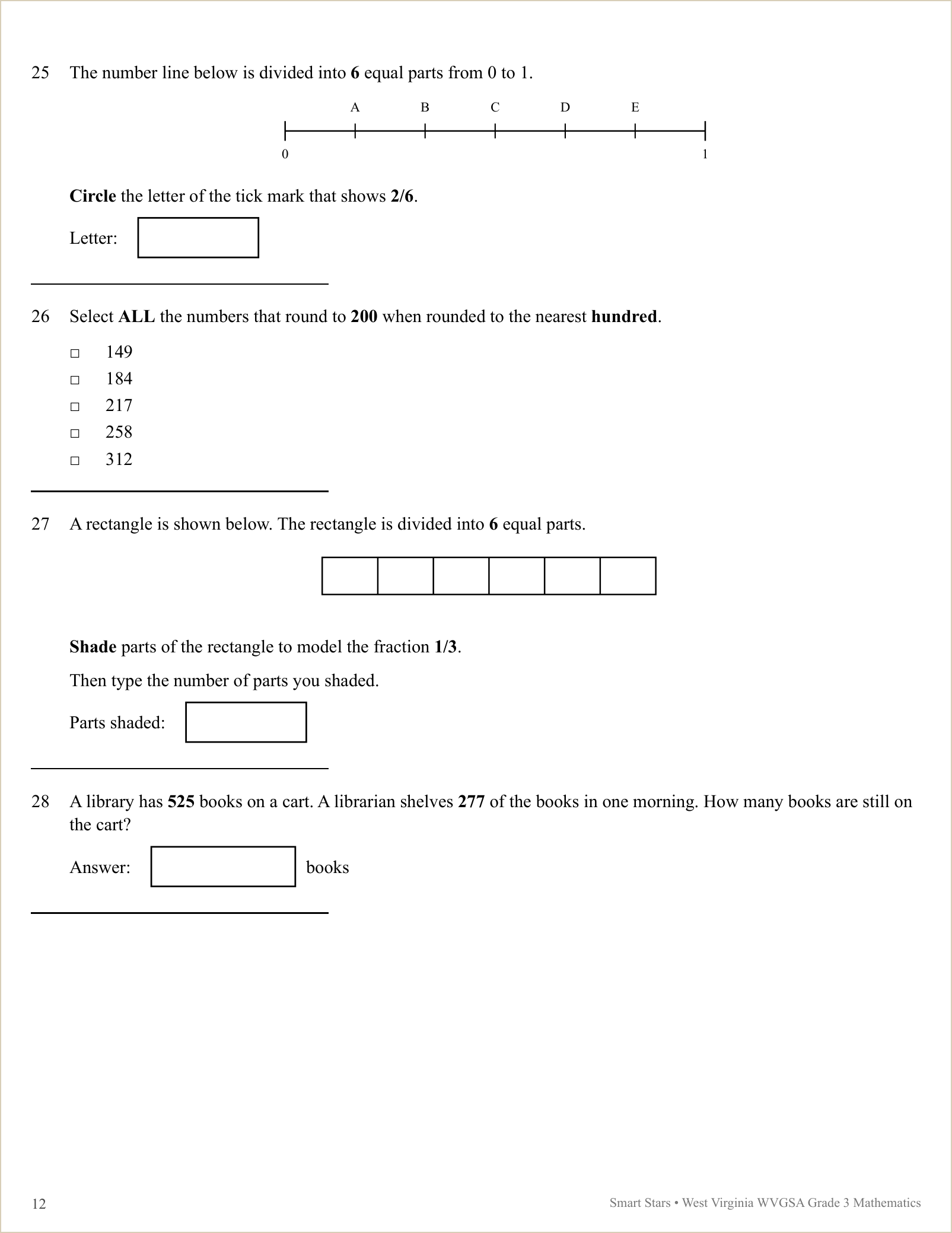
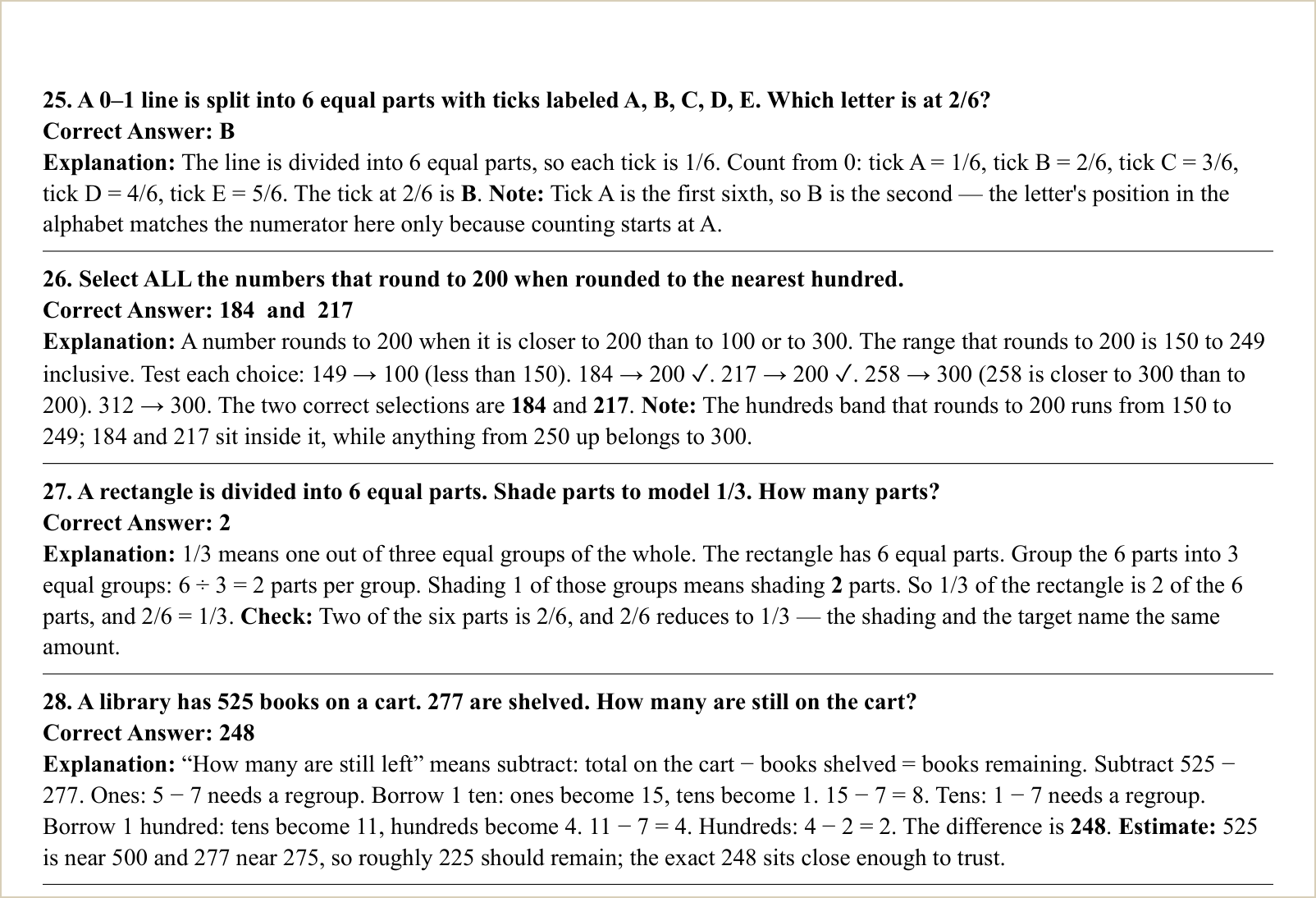
(This includes the technology-enhanced item types and the embedded field-test items that appear on the actual WVGSA, so each practice test mirrors the true 42-item count and helps your child build real-world test “endurance” for the full sitting.)
On test day: the Grade 3 WVGSA is untimed, and most students complete the mathematics test in roughly 60–90 minutes.
What’s inside
- 5 complete 42-question practice tests (210 questions total)
- Single-session CAT format that mirrors test day, with no calculator on any item, no formula sheet, and no on-screen ruler — exactly matching the real Grade 3 WVGSA delivery
- 34 scored items plus 8 unmarked field-test items per test, mixed in throughout — the same ratio the real WVGSA uses, so students build stamina for the live test’s true length
- Detailed answer explanations for every question — not just the correct answer, but step-by-step reasoning that builds real understanding, ending with a labeled Strategy and Tip drawn from the Smart Stars master sub-skill templates
- Item types, names, and contexts varied across all 5 tests, so students never see the same problem twice in the same slot
- Difficulty progression across the series: Test 1 matches the operational baseline, and Tests 2–5 step up roughly 5% each so that Test 5 is calibrated for the upper edge of Grade 3 readiness
- Reporting categories grouped exactly as on the official WVGSA: Operations & Algebraic Thinking; Number & Operations in Base Ten and Fractions; and Measurement, Data & Geometry
- A parent letter with test-taking tips and a Student Reference page covering every metric unit and math symbol used in the book
- A per-item Answer Key embedded with each test’s Answers and Explanations section for fast scoring
Topics covered
- Multiplication and division within 100, with fluency goals through 10 × 10
- Properties of multiplication: commutative, associative, and distributive
- Solving for the unknown in multiplication and division equations
- Two-step word problems using all four operations
- Arithmetic patterns from addition and multiplication tables, including skip-counting and function tables
- Place value through 1,000 — reading, writing, comparing, and rounding to the nearest 10 and 100
- Multi-digit addition and subtraction within 1,000, including regrouping across zeros
- Multiplying one-digit whole numbers by multiples of 10
- Fractions on a number line (denominators 2, 3, 4, 6, and 8)
- Equivalent fractions using visual models and number lines
- Comparing fractions with the same numerator or the same denominator
- Writing whole numbers as fractions with a stated denominator
- Telling and writing time to the nearest minute on analog clocks
- Elapsed time within and across the hour
- Selecting reasonable metric units of mass and liquid volume (grams, kilograms, milliliters, liters)
- Word problems involving masses and liquid volumes
- Picture graphs and bar graphs, including “in all” and “how many more” interpretations
- Line plots measured in halves and fourths of an inch
- Area of rectangles by tiling and by formula, including composite L-shape areas
- Perimeter of polygons, including reverse perimeter-to-side problems
- Categorizing two-dimensional shapes by attributes (parallelograms, rectangles, rhombi, squares, trapezoids)
- Partitioning shapes into equal areas to express unit fractions
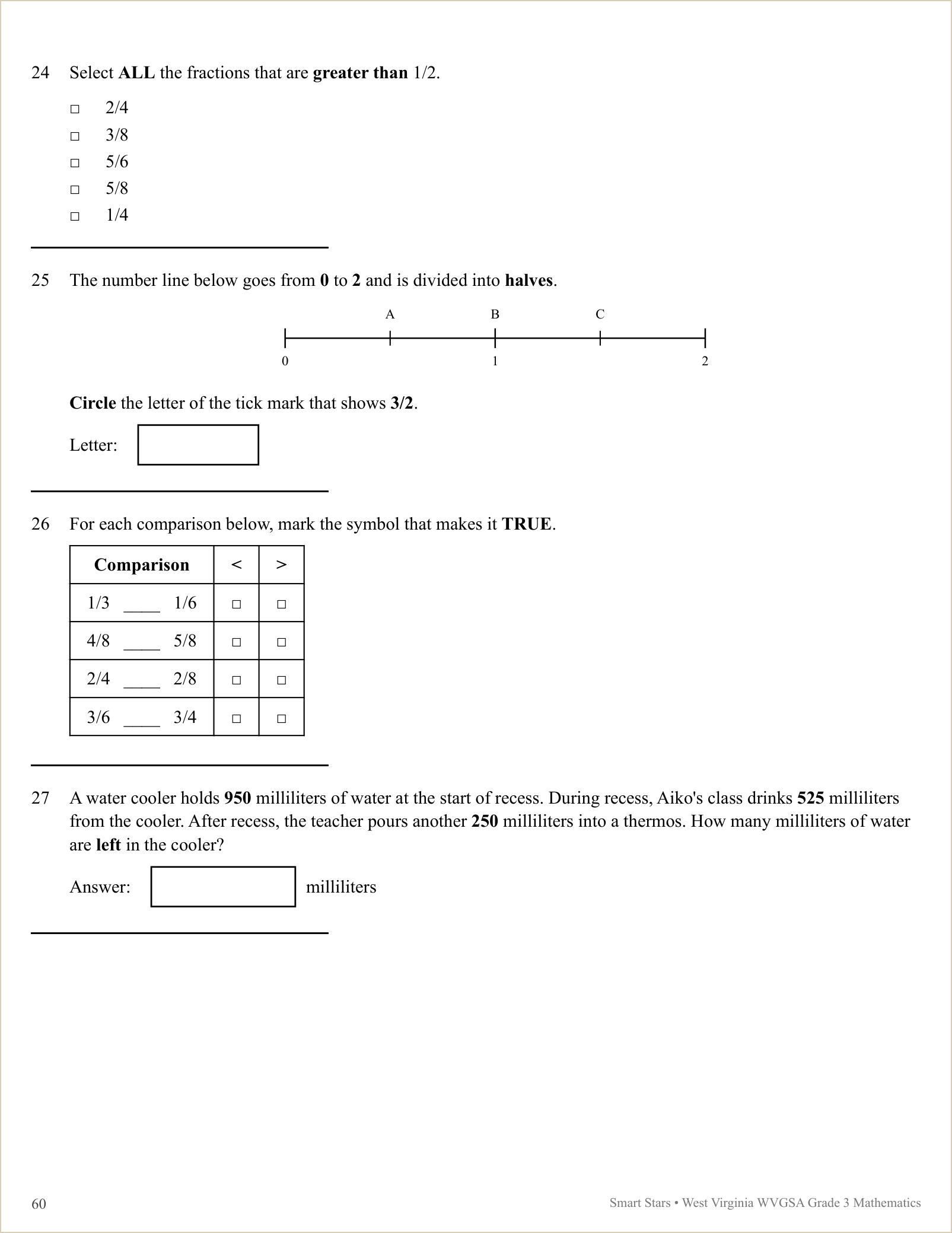
Why parents and teachers choose Smart Stars
- Written by experienced educators who study West Virginia’s official WVGSA test development volumes, the WV College- and Career-Readiness Standards, and the live Cambium Test Delivery System
- Every question mirrors what students will see on test day — no surprises in format, content, or rigor
- Explanations teach the “why,” not just the “what,” so students learn from every mistake — every explanation closes with a labeled Strategy and Tip pulled verbatim from the Smart Stars master sub-skill templates, so a student who studies “round to a place” in this book reads the exact same Strategy in the Grade 4 and Grade 5 books
- Item types and contexts varied across the five tests — just like a real exam, every question feels fresh
- Field-test items embedded but unlabeled — exactly as the real WVGSA mixes them — so students build true test stamina without test-day surprises