North Carolina Practice Tests
North Carolina Practice Books and Flashcards
EOG·
North Carolina's State Tests at a Glance
In grades 3 through 8, North Carolina's End-of-Grade (EOG) tests cover reading and math every year, plus science in grades 5 and 8. The tests are taken online through NCTest, the state's testing platform, and paper versions are available for students who need them for accessibility. The EOGs are multistage adaptive tests, given during the final ten days of the school year. Each test is scheduled as three 40-minute work segments with two three-minute breaks; the state estimates that most students finish in about two hours, and no student may take more than three hours unless an accommodation such as extended time allows it.
Reading
| Grade | Format | Time | What’s tested |
|---|---|---|---|
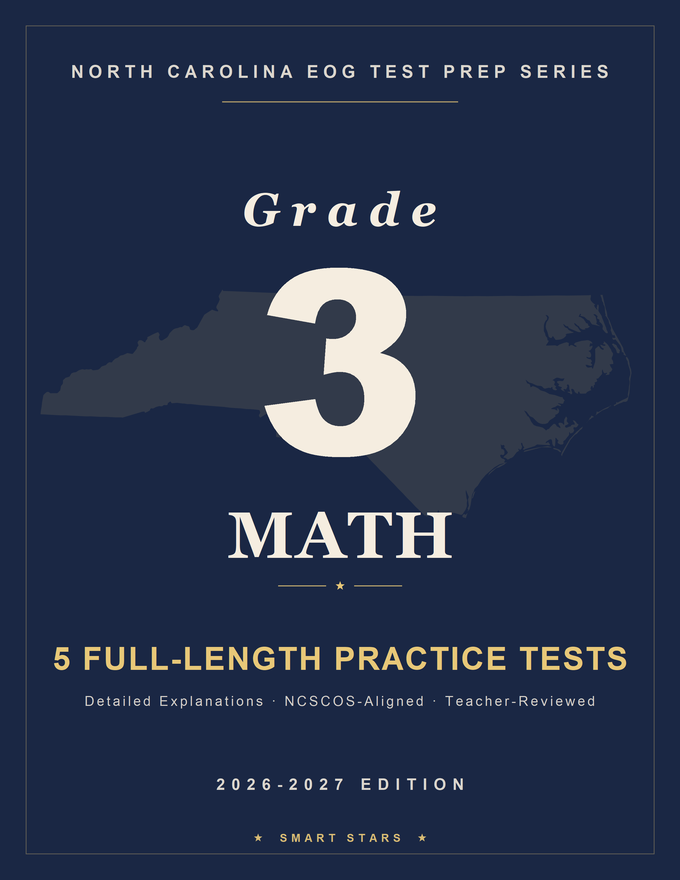
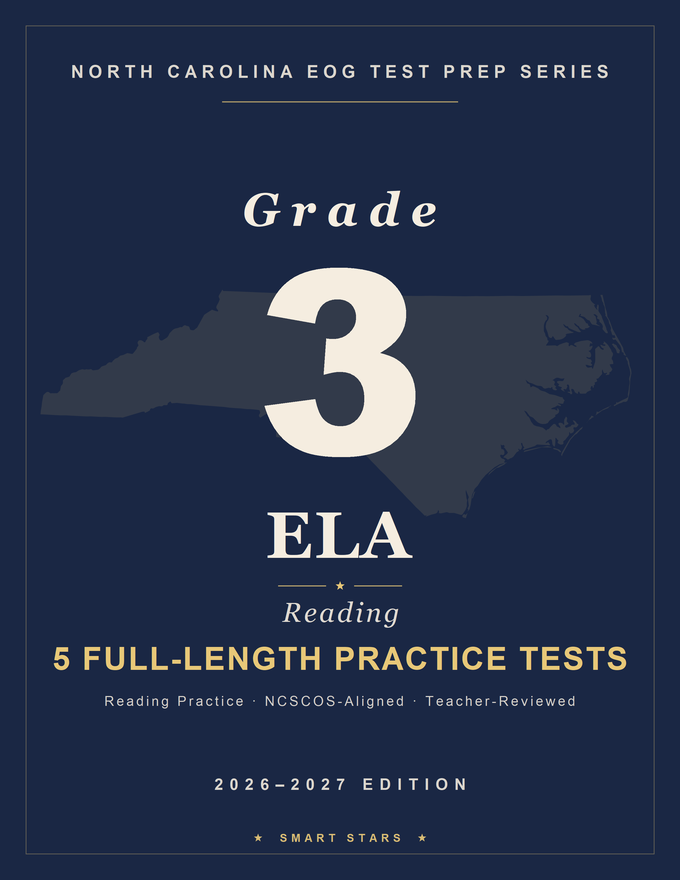
| Grade 3 | Online; multistage adaptive; each reading selection split into two parts, with questions after each part; multiple-choice and technology-enhanced questions; no writing | About 120 minutes for most students; 180 minutes maximum | Reading for informational text (46 to 50%), reading for literature (38 to 42%), language (13 to 15%) |
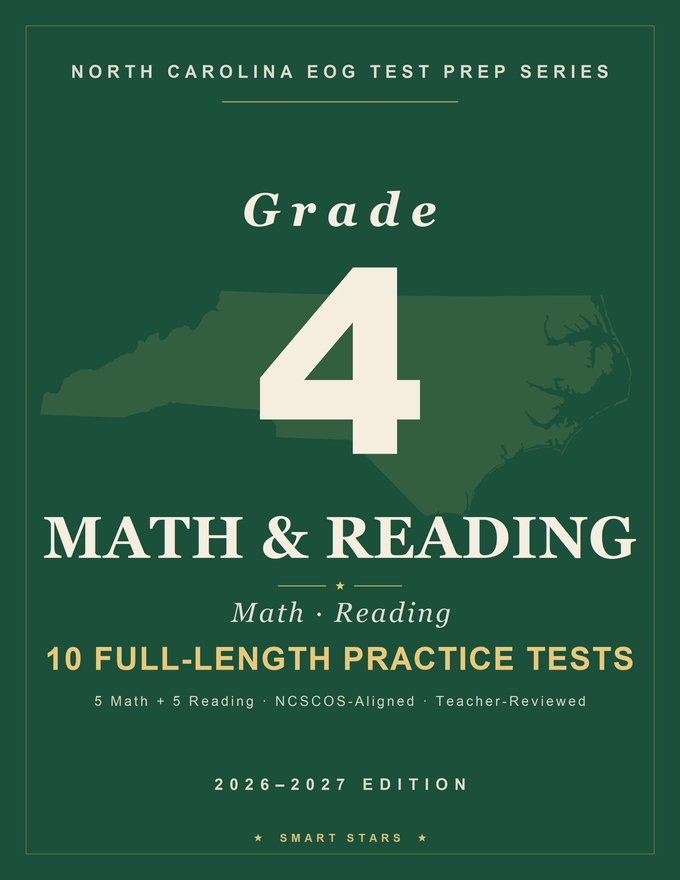
| Grades 4 and 5 | Online; multistage adaptive; reading selections with multiple-choice and technology-enhanced questions; no writing | About 120 minutes for most students; 180 minutes maximum | Reading for informational text (46 to 50%), reading for literature (38 to 42%), language (13 to 15%) |
| Grades 6, 7 and 8 | Online; multistage adaptive; reading selections with multiple-choice and technology-enhanced questions; no writing | About 120 minutes for most students; 180 minutes maximum | Reading for informational text (43 to 47%), reading for literature (36 to 41%), language (11 to 16%) |
The EOG reading test assesses reading standards only, so there is no essay or writing task. Third graders also take the Beginning-of-Grade 3 Reading Test online in the first fifteen days of the school year, and under North Carolina's Read to Achieve law, a third grader who has not yet shown reading proficiency may take a retest of the grade 3 reading test or the Read to Achieve Test.
Mathematics
| Grade | Format | Time | What’s tested |
|---|---|---|---|
| Grade 3 | Online; multistage adaptive; a calculator-inactive section and a calculator-active section; four-function calculator in the calculator-active section | About 120 minutes for most students; 180 minutes maximum | Operations and algebraic thinking (32 to 36%), number and operations in base ten (9 to 13%), fractions (28 to 32%), measurement and data, and geometry (23 to 27%) |
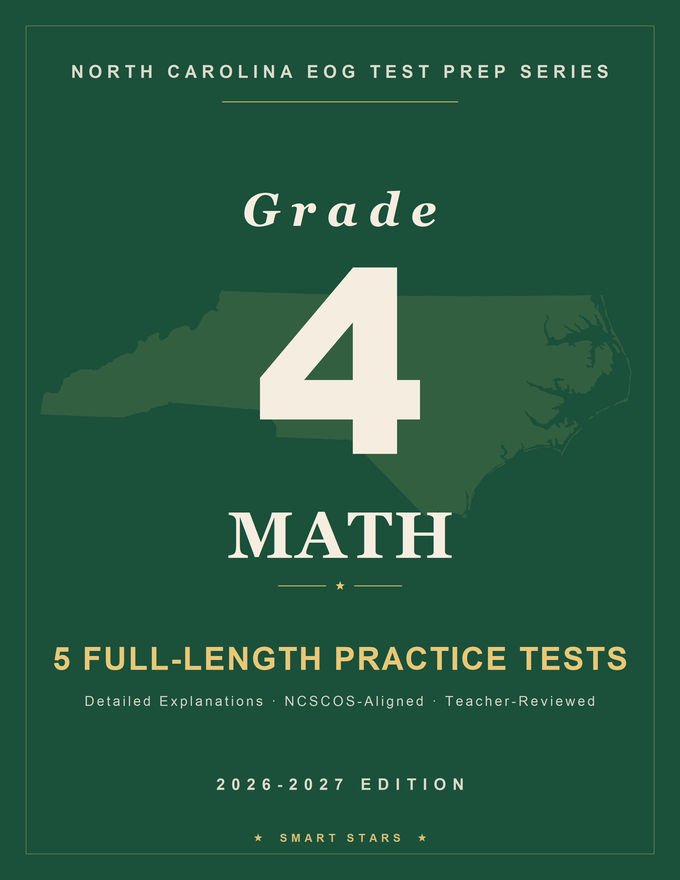
| Grade 4 | Online; multistage adaptive; a calculator-inactive section and a calculator-active section; four-function calculator in the calculator-active section | About 120 minutes for most students; 180 minutes maximum | Operations and algebraic thinking (14 to 18%), number and operations in base ten (25 to 29%), fractions (30 to 34%), measurement and data, and geometry (23 to 27%) |
| Grade 5 | Online; multistage adaptive; a calculator-inactive section and a calculator-active section; four-function calculator in the calculator-active section | About 120 minutes for most students; 180 minutes maximum | Operations and algebraic thinking (9 to 13%), number and operations in base ten (25 to 29%), fractions (39 to 43%), measurement and data, and geometry (19 to 23%) |
| Grade 6 | Online; multistage adaptive; a calculator-inactive section and a calculator-active section; scientific calculator in the calculator-active section | About 120 minutes for most students; 180 minutes maximum | Ratios and proportional relationships (24 to 28%), the number system (20 to 24%), expressions and equations (22 to 26%), geometry (12 to 16%), statistics and probability (12 to 16%) |
| Grade 7 | Online; multistage adaptive; a calculator-inactive section and a calculator-active section; scientific calculator in the calculator-active section | About 120 minutes for most students; 180 minutes maximum | Ratios and proportional relationships (24 to 28%), the number system (8 to 12%), expressions and equations (20 to 24%), geometry (16 to 20%), statistics and probability (22 to 26%) |
| Grade 8 | Online; multistage adaptive; a calculator-inactive section and a calculator-active section; scientific and graphing calculators in the calculator-active section | About 120 minutes for most students; 180 minutes maximum | The number system, and expressions and equations (24 to 28%), functions (28 to 32%), geometry (24 to 28%), statistics and probability (16 to 20%) |
Questions are multiple choice, gridded response (numeric entry) and technology-enhanced, and every question is worth one point. The online test has a built-in calculator for the calculator-active section, and students may ask for graph paper and scratch paper.
Science
| Grade | Format | Time | What’s tested |
|---|---|---|---|
| Grade 5 | Online; multistage adaptive; stand-alone questions plus item sets that share reference material | About 120 minutes for most students; 180 minutes maximum | Physical science (30 to 37%), life science (44 to 52%), earth and space science (18 to 25%) |
| Grade 8 | Online; multistage adaptive; stand-alone questions plus item sets that share reference material; periodic table provided | About 120 minutes for most students; 180 minutes maximum | Physical science (16 to 22%), life science (33 to 41%), earth and space science (42 to 50%) |
The science tests are built on North Carolina's science standards adopted in 2023. Questions are multiple choice and technology-enhanced. A computer-generated read-aloud of the test is available as a designated feature when the teacher approves it, and grade 8 students can use an online periodic table or ask for a paper copy.