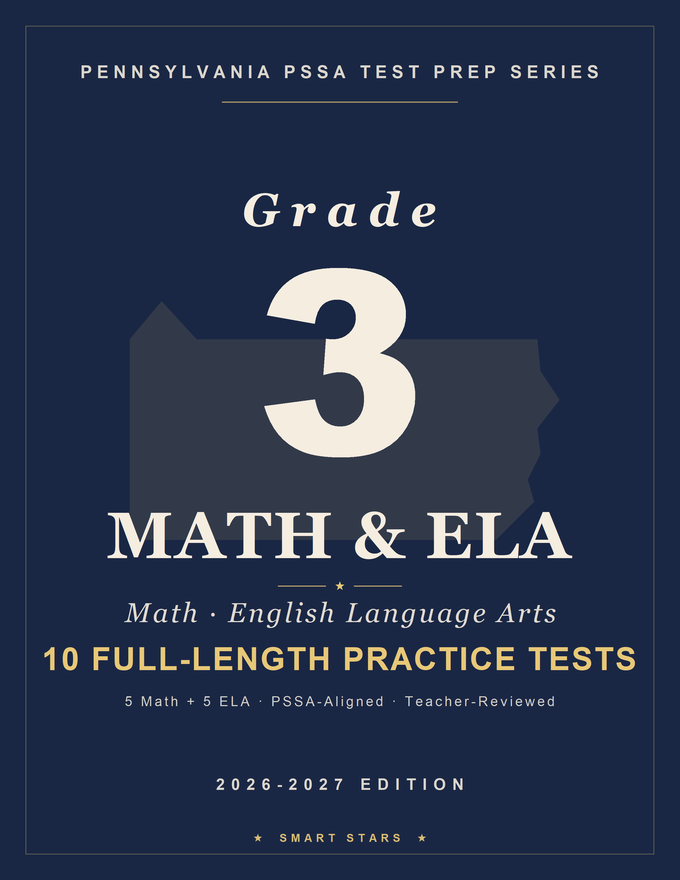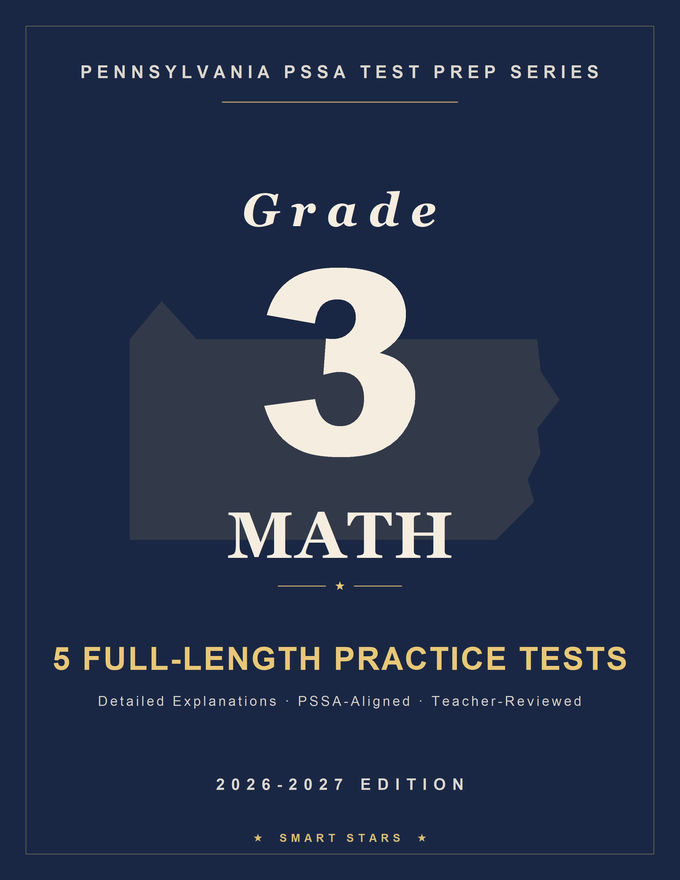
Give your third grader the confidence to succeed on the Pennsylvania System of School Assessment (PSSA) Mathematics test.
This book contains five full-length practice tests — 215 questions total — aligned to PA Core Mathematics and the Pennsylvania Department of Education’s Assessment Anchors and Eligible Content (M03) for Grade 3 and designed to match the format, difficulty, and content of the real Grade 3 PSSA Math exam.
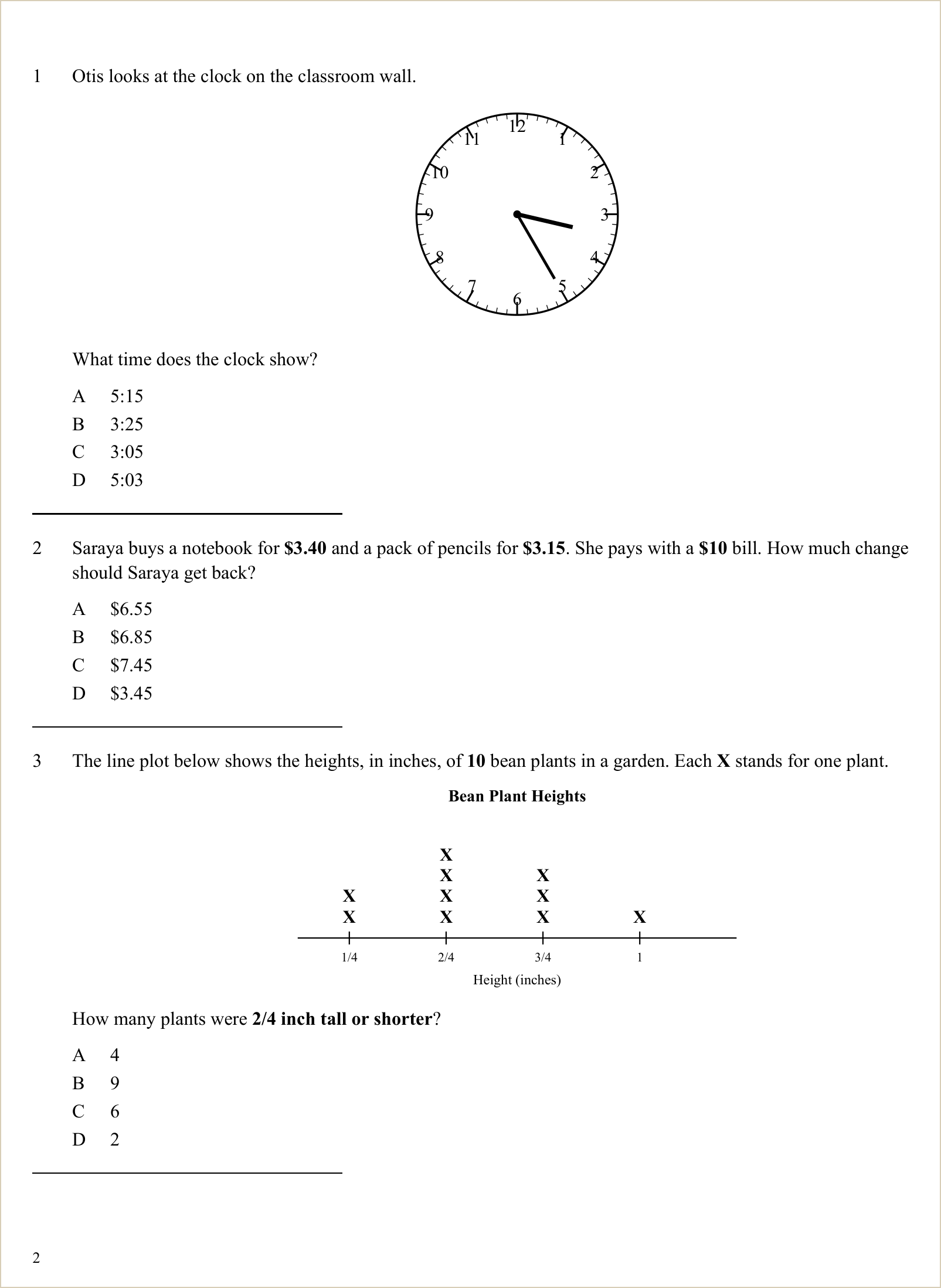
Take a look inside
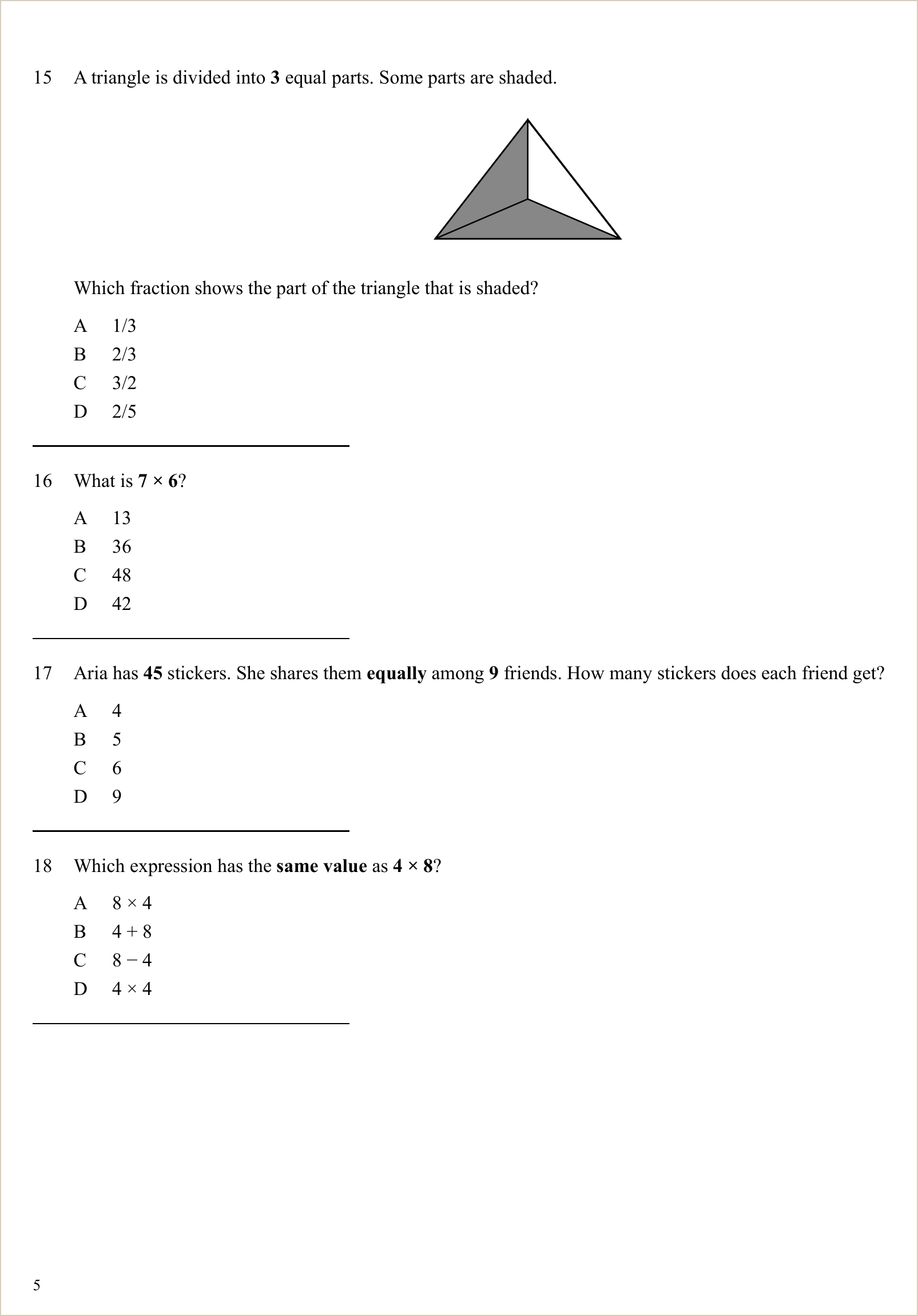
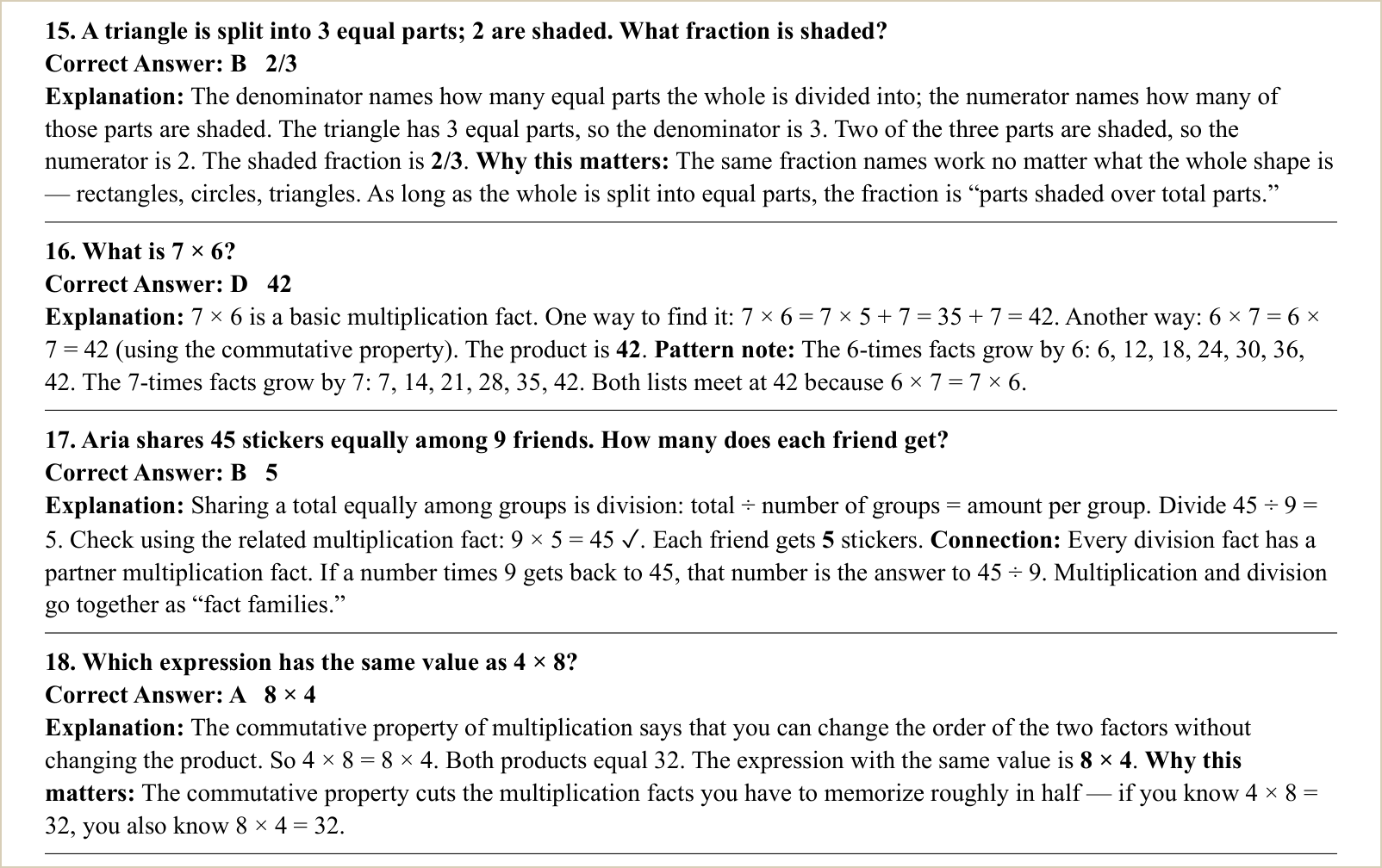
(This includes the open-ended constructed-response items and technology-enhanced item types that appear on the actual PSSA exam, so each practice test mirrors the true 43-item count and helps your child build real-world test “endurance” for the full sitting.)
On test day: a full Grade 3 PSSA Mathematics section runs about 75–90 minutes.
What’s inside
- 5 complete 43-question practice tests (215 questions total)
- Two-section format that mirrors test day: Section 1 (Questions 1–26) and Section 2 (Questions 27–43), with a STOP marker between the sections exactly as on the real PSSA, and no calculator on any item
- 40 multiple-choice and technology-enhanced items plus 3 open-ended questions per test — each open-ended item is divided into four sub-parts worth 1 point each, scored with the full PSSA scoring guidelines
- Detailed answer explanations for every question — not just the correct letter, but step-by-step reasoning that builds real understanding, plus model student responses and partial-credit guidance for every open-ended item
- Item types, names, and contexts varied across all 5 tests, so students never see the same problem twice in the same slot
- Reporting categories grouped exactly as on the official test: Numbers and Operations in Base Ten (M03.A-T), Numbers and Operations – Fractions (M03.A-F), Operations and Algebraic Thinking (M03.B-O), Geometry (M03.C-G), and Measurement and Data (M03.D-M)
- A parent letter with test-taking tips and a guide to scoring open-ended items at home
- A quick-reference answer key for all five tests for fast scoring
Topics covered
- Place value through 10,000 — reading, writing, comparing, and ordering whole numbers
- Rounding whole numbers to the nearest 10 and nearest 100
- Multiplying one-digit whole numbers by multiples of 10 within 100
- Multiplication facts through 10 × 10 with automaticity
- Division within 50 (dividends through 50, divisors and quotients through 10)
- Properties of operations: commutative, associative, and distributive
- Solving for the unknown in multiplication and division equations
- Identifying multiples of a one-digit whole number
- Two-step word problems using all four operations
- Arithmetic patterns from addition and multiplication tables
- Fractions on a number line, including whole numbers as fractions
- Equivalent fractions using visual models and number lines
- Comparing fractions with the same numerator or the same denominator (denominators 2, 3, 4, 6, and 8)
- Identifying and comparing two-dimensional shapes by attributes
- Polygon definition, quadrilateral classification, and partitioning shapes into equal parts
- Telling and writing time to the nearest minute on analog clocks
- Elapsed time within and across the hour
- Money: counting coins and bills, making change, and writing dollar-and-cent amounts
- Selecting reasonable units of mass and liquid volume (grams, kilograms, milliliters, liters)
- Word problems involving masses and liquid volumes
- Picture graphs and bar graphs, including half-symbol pictographs
- Line plots measured in halves and quarters of an inch
- Area of rectangles by tiling and by formula
- Perimeter of polygons, including same-area-different-perimeter reasoning
Why parents and teachers choose Smart Stars
- Written by experienced educators who study Pennsylvania’s official PSSA Assessment Anchors, Eligible Content, and released item samplers
- Every question mirrors what students will see on test day — no surprises in format, content, or rigor
- Explanations teach the “why,” not just the “what,” so students learn from every mistake — every explanation closes with a labeled Strategy, Tip, Check, or Connection that links the skill to the broader Grade 3 standards
- Item types and contexts varied across the five tests — just like a real exam, every question feels fresh
- Open-ended items include full scoring rubrics so parents and teachers can award partial credit at home exactly the way PDE scores the live test