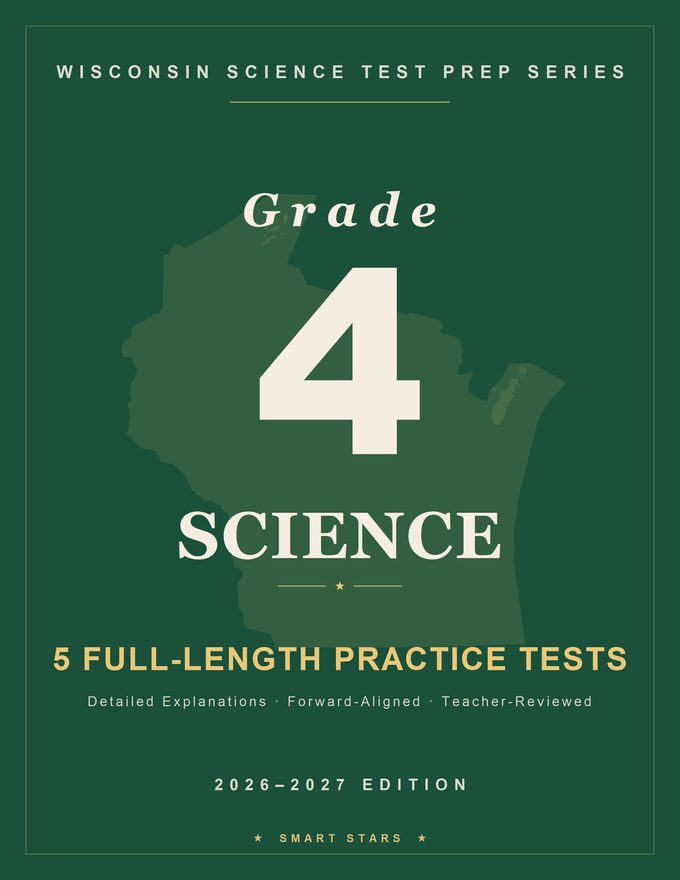
Give your fourth grader the confidence to succeed on the science portion of the Wisconsin Forward Exam.
Five full-length practice tests — 225 questions — aligned to the Wisconsin Standards for Science (2017). Science is tested on the Forward Exam at grades 4 and 8 only, so this is the first and only elementary science assessment most Wisconsin families meet, and little practice material exists for it.
Take a look inside
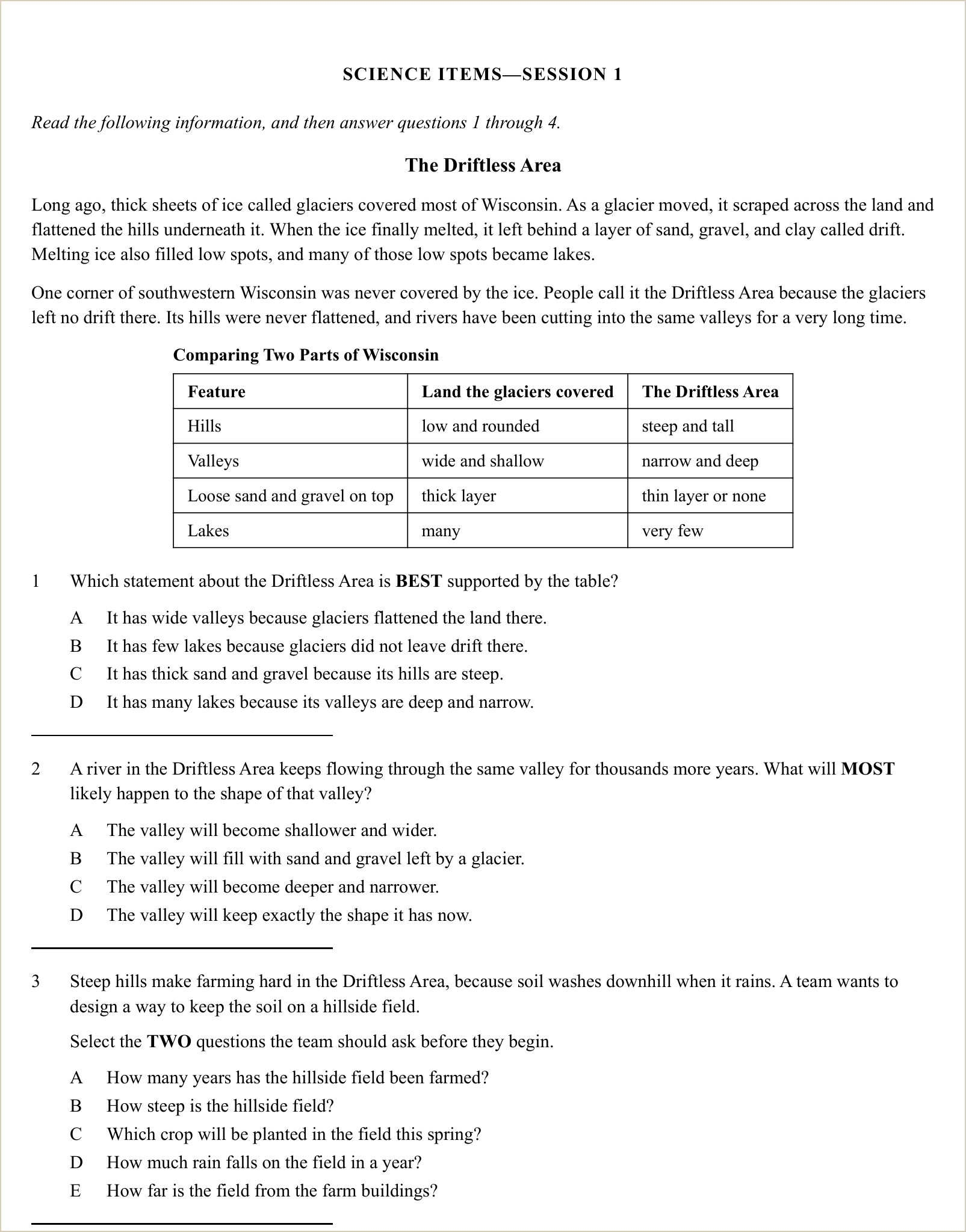
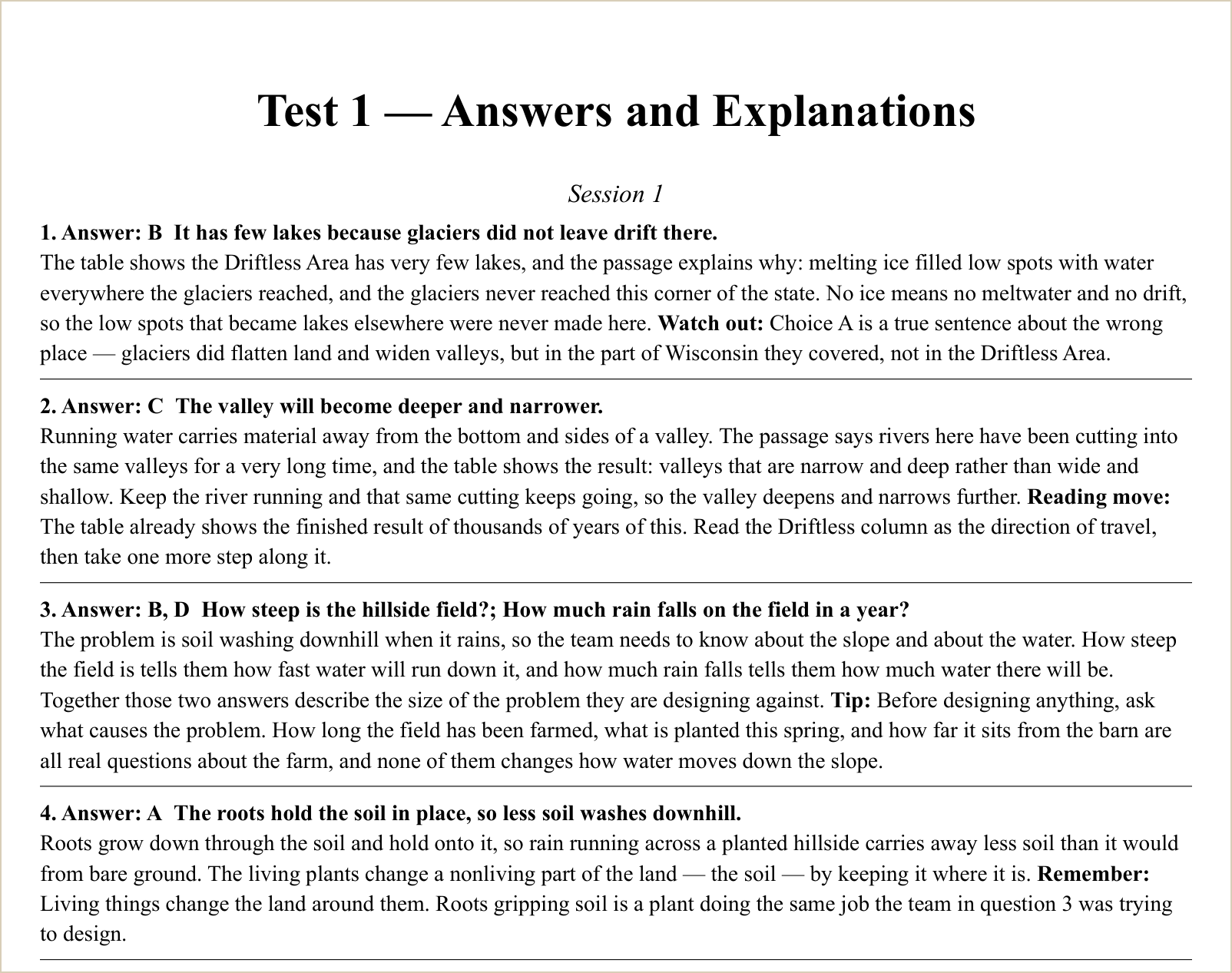
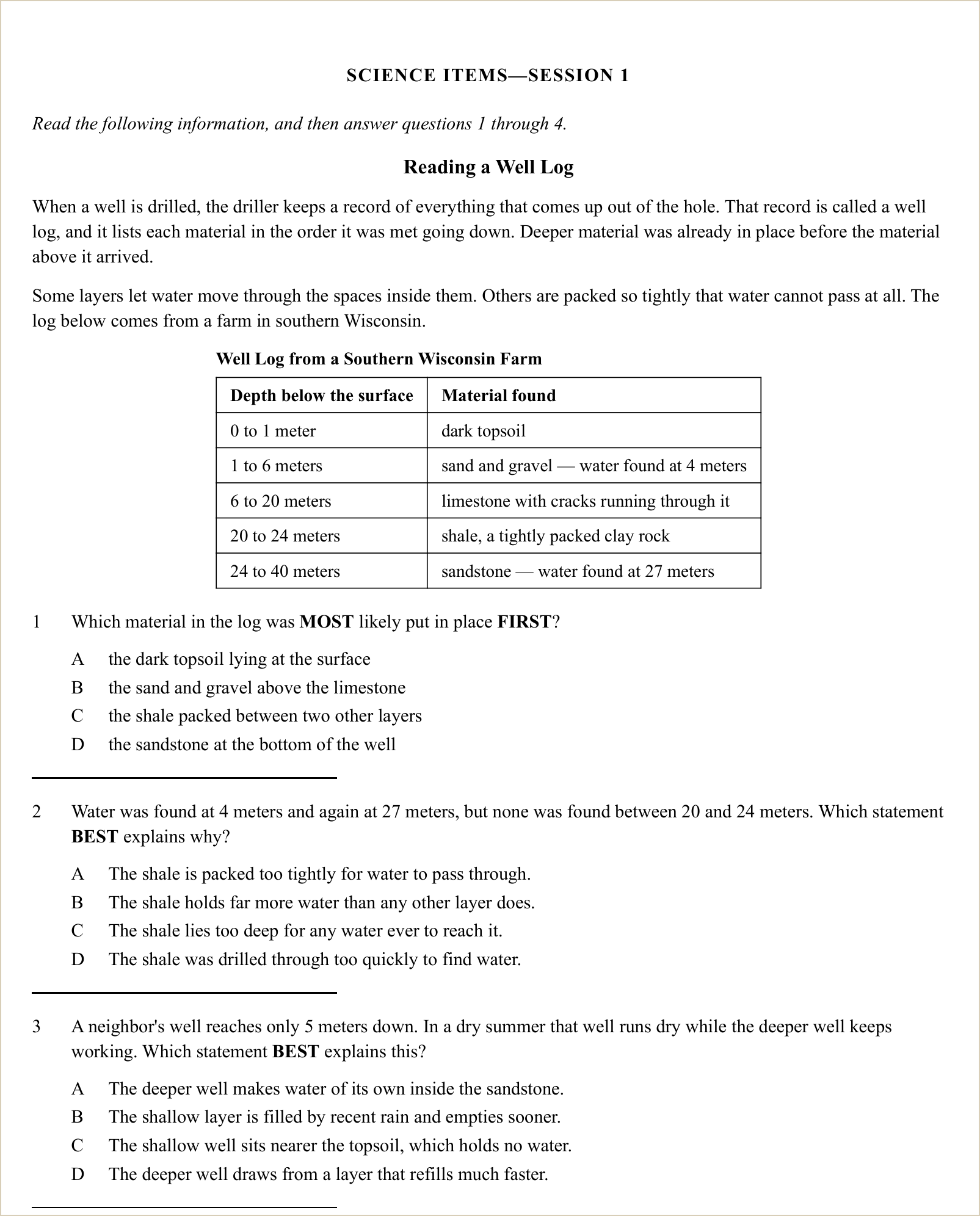
Built the way the real test is built: The test runs in three sessions of fifteen questions, and the numbering starts again at 1 in every session — so a child sees “1” three times in one sitting. Every test here does the same. Practiced only on continuous numbering, a student meets that first on test day.
Most questions arrive in sets: 180 of the 225 sit in one of 45 sets — each opening with a passage, data table, diagram, or model, then four questions about it. The other 45 stand alone, the mix Wisconsin uses: the information is in front of the student, and the work is deciding what it means.
Not one question can be answered from memory: Every item asks a child to use what is given. Of the 225 questions, 78 sit at Depth of Knowledge level 2 and 147 at level 3 — not a single level 1 recall question, because the real test has none.
A full sitting, and no wasted questions.
- Length: a real Grade 4 form runs 45 questions but only 40 of them count.
- Field-test items: the other five are field-test questions — items being tried out for future tests, which look exactly like the rest, so a student cannot tell which is which. That is why the sitting runs 45 while Wisconsin scores it out of 40, its four categories carrying 8 to 12 points each.
- Each practice test here: the same 45-question sitting, so practice runs the true length and your child builds the stamina for it — the difference being that all 45 here are scored-style questions with full explanations.
So no practice time goes on a question that would not have counted.
On test day: the Grade 4 Forward Exam science test is untimed.
What’s inside
- The same category balance on every test: 12 Life Science, 12 Physical Science, 12 Earth and Space Science, 9 Engineering
- 188 four-choice questions, 22 “choose two,” and 15 two-part questions asking for the evidence behind the answer — the three types Wisconsin uses. No written response, because the test has none. Engineering is folded into the other sets, never given its own reading
- 43 original data tables and 16 original diagrams — sound waves, rock layers, a beaver dam, a fox listening for a vole under snow — drawn to be measured, not decorated
- Wrong answers are real fourth-grade mistakes, so a wrong choice tells you what to reteach
- Wisconsin settings named throughout — Neenah, Baraboo, Portage, Viroqua, Rhinelander, Menomonie, Muscoda, the Kickapoo and Chippewa Rivers, Vilas County, the Driftless Area
- A family letter, seven test-specific tips, a Grade 4 Science Study Reference, and a Quick Answer Key
Topics covered
- Life Science: animal and plant structures and the jobs they do; how animals take in information and act — echolocation, alarm calls, a tongue that reads scent; inherited versus learned behavior; surviving a Wisconsin winter
- Physical Science: energy of motion and stored energy; transfer through friction and burning; heat moving warm to cool; sound as vibration, with loudness from wave height and pitch from spacing; light, shadow, reflection, and color; signals sent over distance
- Earth and Space Science: the glaciers that shaped the state and the Driftless Area they missed; erosion and deposition; rock layers and fossils; Wisconsin water from cranberry marshes to the spring melt; natural hazards and resources
- Engineering: defining a problem before designing; fair comparisons; choosing what to measure; judging whether a design worked
Pair it with the flashcards
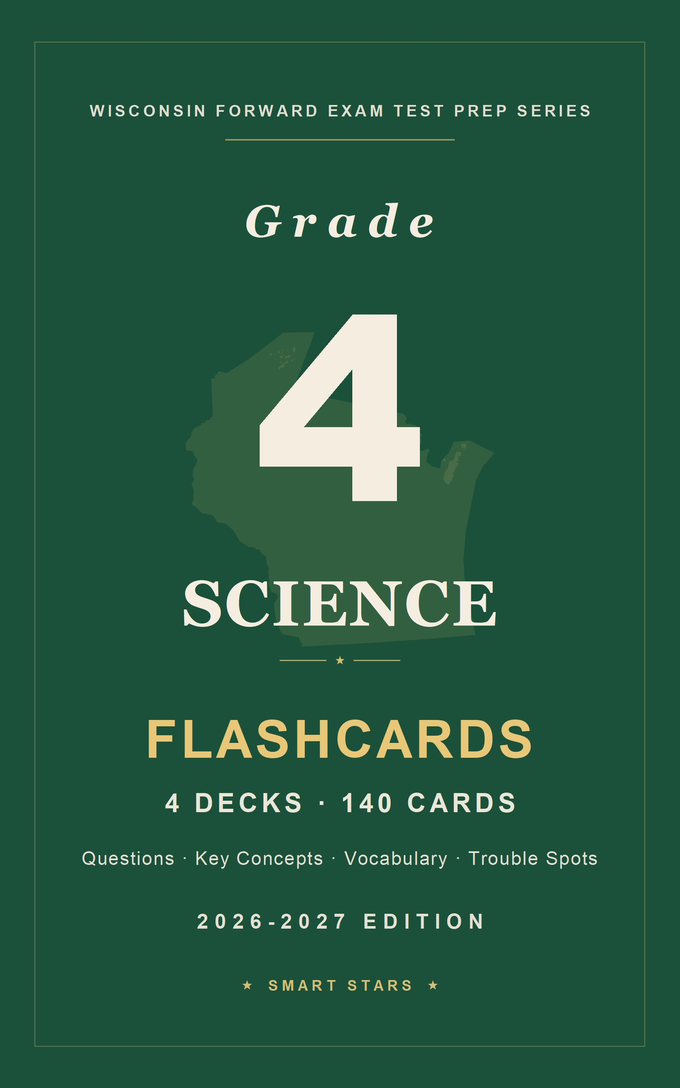
Smart Stars Wisconsin Forward Exam Grade 4 Science Flashcards: Four Decks, 140 Cards
140 cards in four decks: Like Test Day, Key Concepts, Vocabulary, and Trouble Spots. Short review sessions between practice tests, on a phone, a tablet, or a Kindle.