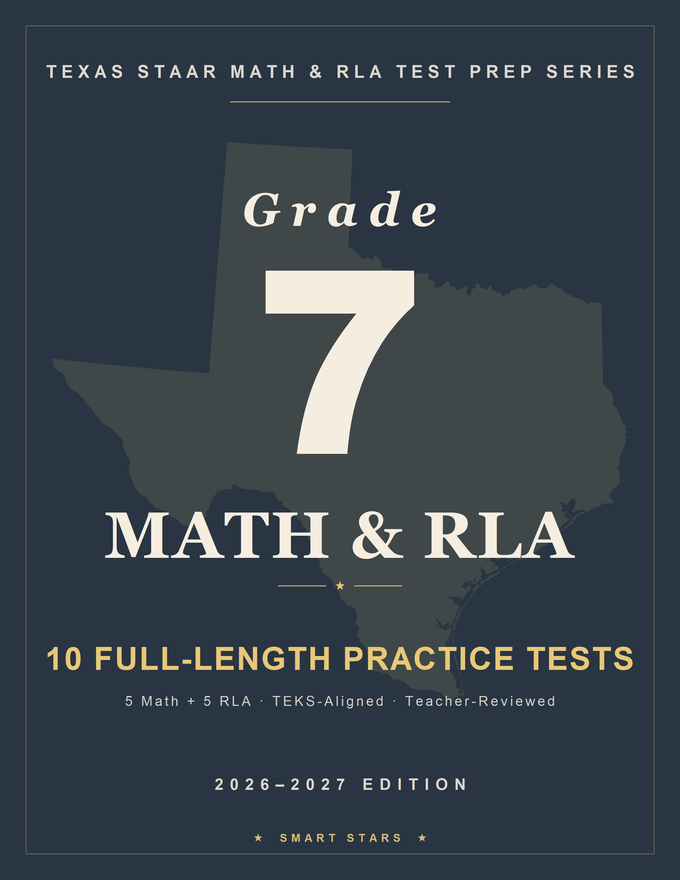
Give your seventh grader the confidence to succeed on the State of Texas Assessments of Academic Readiness (STAAR) — in BOTH Mathematics and Reading Language Arts — with one comprehensive practice book.
This volume contains ten full-length practice tests — 415 questions in all — aligned to the Texas Essential Knowledge and Skills for Grade 7 and built to the shape of the real Grade 7 STAAR exams.
Take a look inside
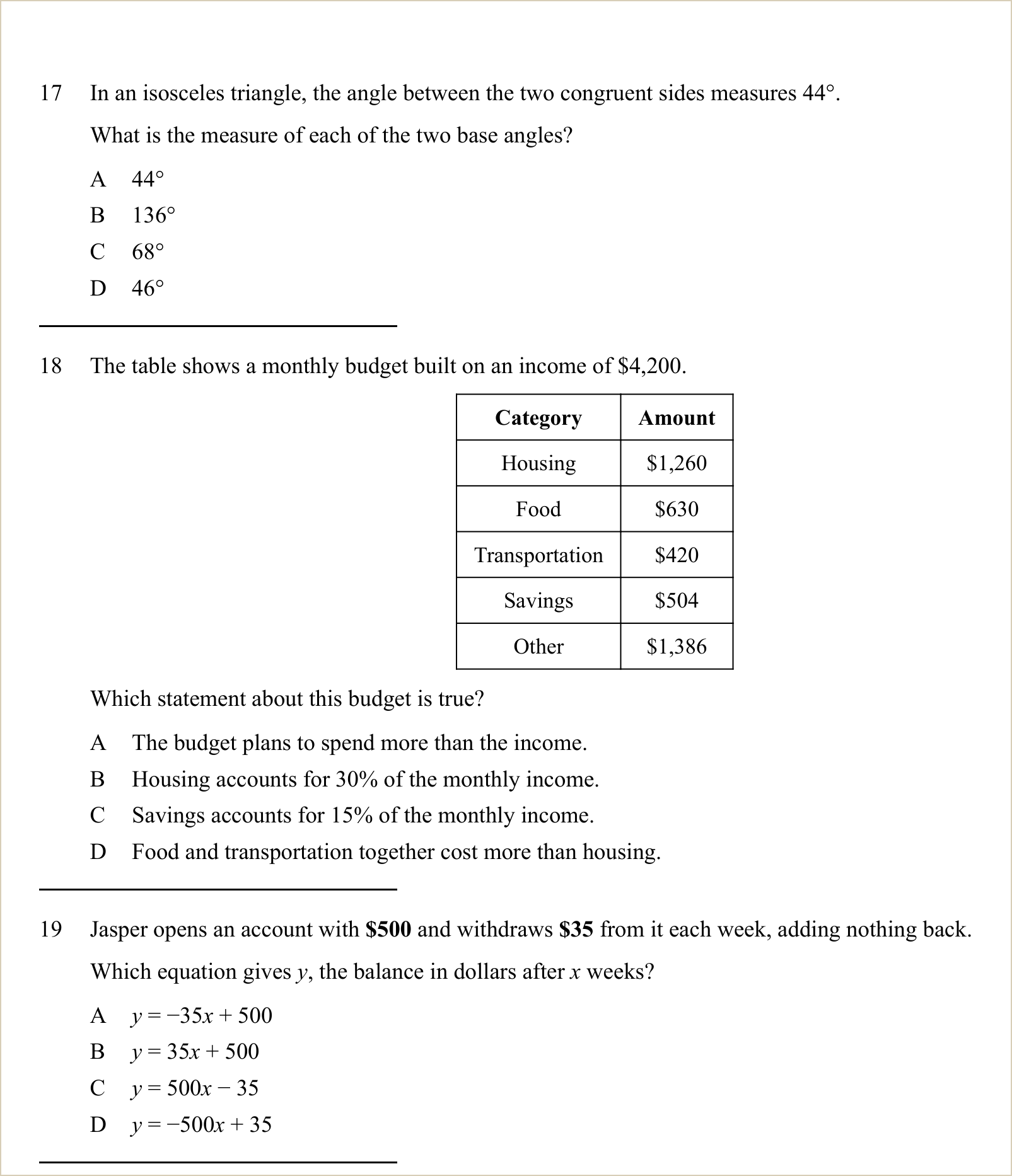
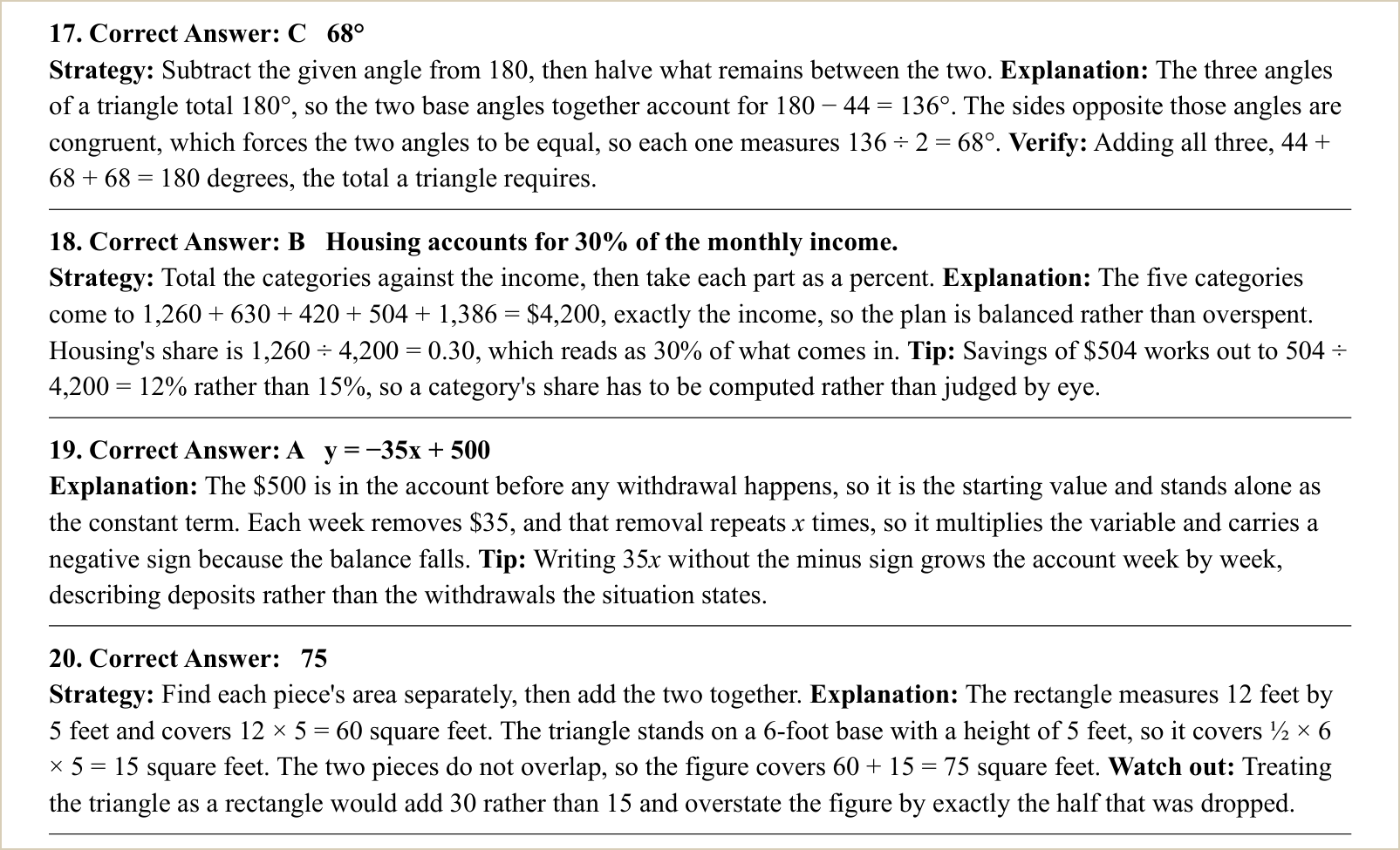
(Please note: these are the same tests sold in our two individual Grade 7 titles, Smart Stars Texas STAAR Grade 7 Math and Grade 7 Reading Language Arts. This bundle exists to save families money when a student is preparing for both subjects in the same year — if you already own both, it does not add new tests.)
What’s inside
- 5 complete 38-question Mathematics practice tests (190 questions), each worth 46 points exactly as a real form is — 30 one-point and 8 two-point questions, with about four points in ten coming from questions that are not multiple choice
- 5 complete 45-question Reading Language Arts practice tests (225 questions), each worth 56 points, in the real test’s order: reading selections — a story, a poem, informational and argumentative articles, two texts on one topic read together — then the essay, then a student draft to revise and edit
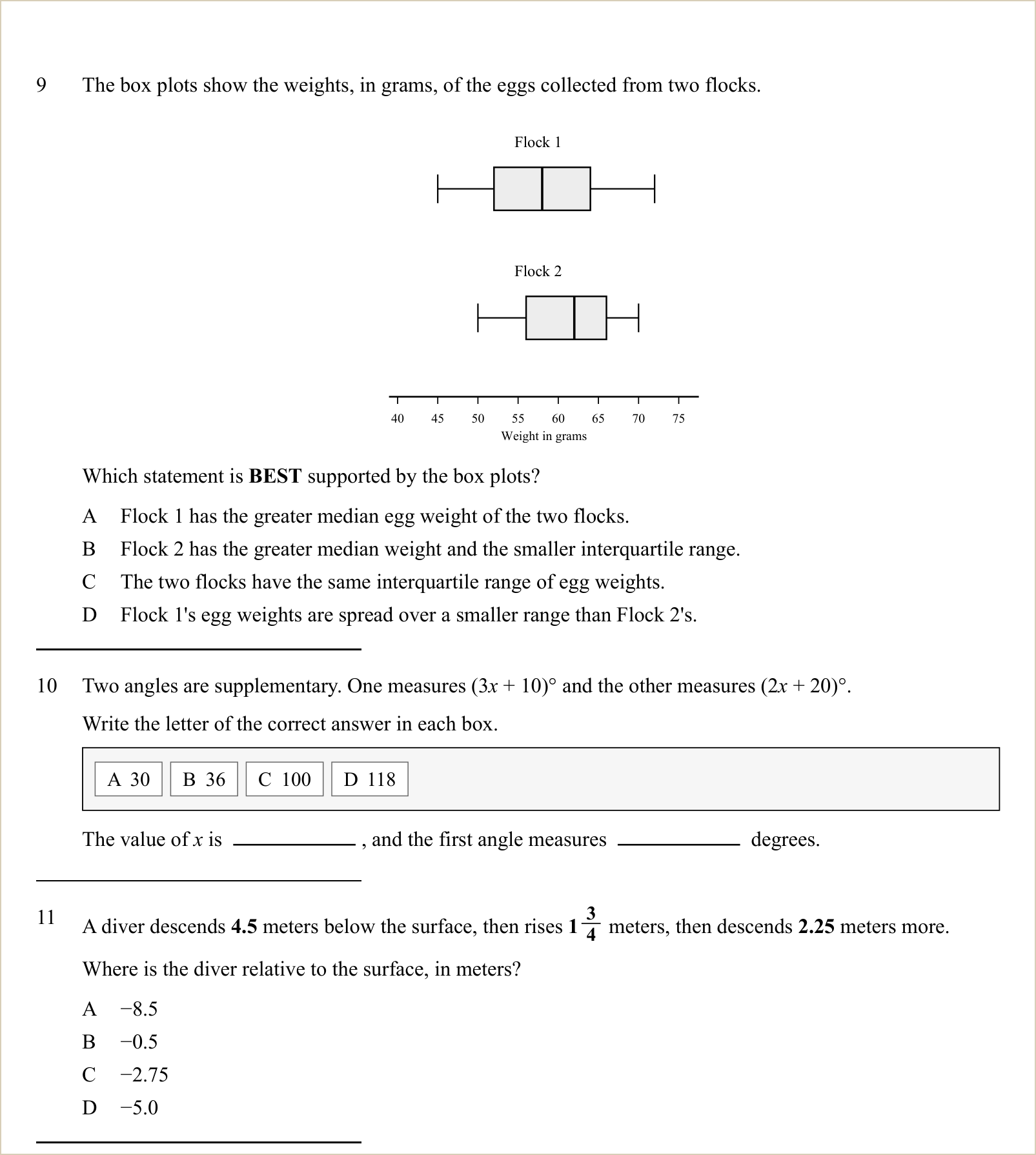
- Every question style on the real tests, rendered for paper: multiple choice, writing letters in boxes, inline choice with lettered answer banks, typed-number answers, and the number-line question where the solution of an inequality is drawn in Math; questions that ask for two correct answers, inline choice, a short constructed response, and the extended constructed response essay in RLA — with no bubble sheet, so students mark directly on the page as they will online
- Thirty-five drawn figures and seven data tables across the Math tests — nets, circles, composite figures, angle diagrams, similar figures, scale drawings, dot plots, box plots, circle graphs, bar graphs, and number lines — every one checked against its own answer key
- Detailed answer explanations for every question: Math shows the steps and closes with a Tip, a Check, a Watch out, or the Big idea; RLA quotes the words in the passage that settle the answer, names the wrong answer a student is most likely to choose and why it tempts, and closes with a labeled note
- Two Study References: the Math one reproduces the real state reference sheet exactly as it is handed out — the circle formulas, the volume of a pyramid, slope-intercept form, simple and compound interest — then adds study pages the test does not provide; the RLA one is a single page of the kinds of question, the written responses and what scorers look for, the revising and editing skills, and the terms a seventh grader should know — and says the real test has no reference sheet
- A parent letter covering both tests — their shape and point structure, no calculator at Grade 7, the 10-point essay and its three modes, passages never read aloud, what each performance level means in Texas’s own words, and why the book prints no “percent to pass”
- Quick answer keys for all ten tests for fast scoring
This book is built for all of it.
Two things surprise families most
- Tools at Grade 7: in Math, there is still no calculator — Grade 7 is a no-calculator test, as Grade 6 was, and a calculator arrives only at Grade 8; every computation here, including the ones with π, is done by hand.
- Written response: in Reading Language Arts, your student writes an essay — beyond the multiple-choice questions, the real test asks for a short constructed response and an extended constructed response worth 10 points on its own — informational, argumentative, or correspondence — and the passages cannot be read aloud to a student, even as an accommodation. Every RLA test here includes short responses and an essay, the five essays rotate through all three modes, and each comes with ruled space to write in, a sample response, and scoring guidance.
Why parents and teachers choose Smart Stars
- Written by experienced educators who study Texas’s official blueprints, released test forms, and scoring guides
- Every question mirrors what students will see on test day — no surprises in format, content, or rigor
- Explanations teach the “why,” not just the “what,” so students learn from every mistake
- Built to the real point structure and the real order, including the two-point Math questions and the 10-point essay students most often meet for the first time on test day
- One book for both subjects, so a family preparing for the whole spring buys once