About this book
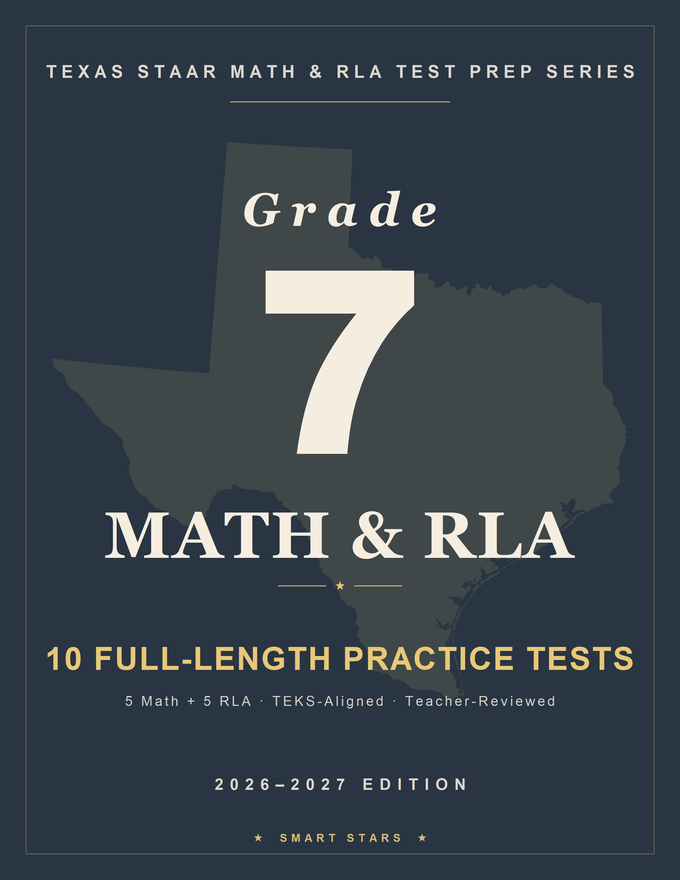
Give your seventh grader the confidence to succeed on the State of Texas Assessments of Academic Readiness (STAAR) Grade 7 Mathematics test.
This book contains five full-length practice tests — 190 questions total — aligned to the Texas Essential Knowledge and Skills for Grade 7 Mathematics and designed to match the format, difficulty, and content of the real STAAR exam.
Take a look inside
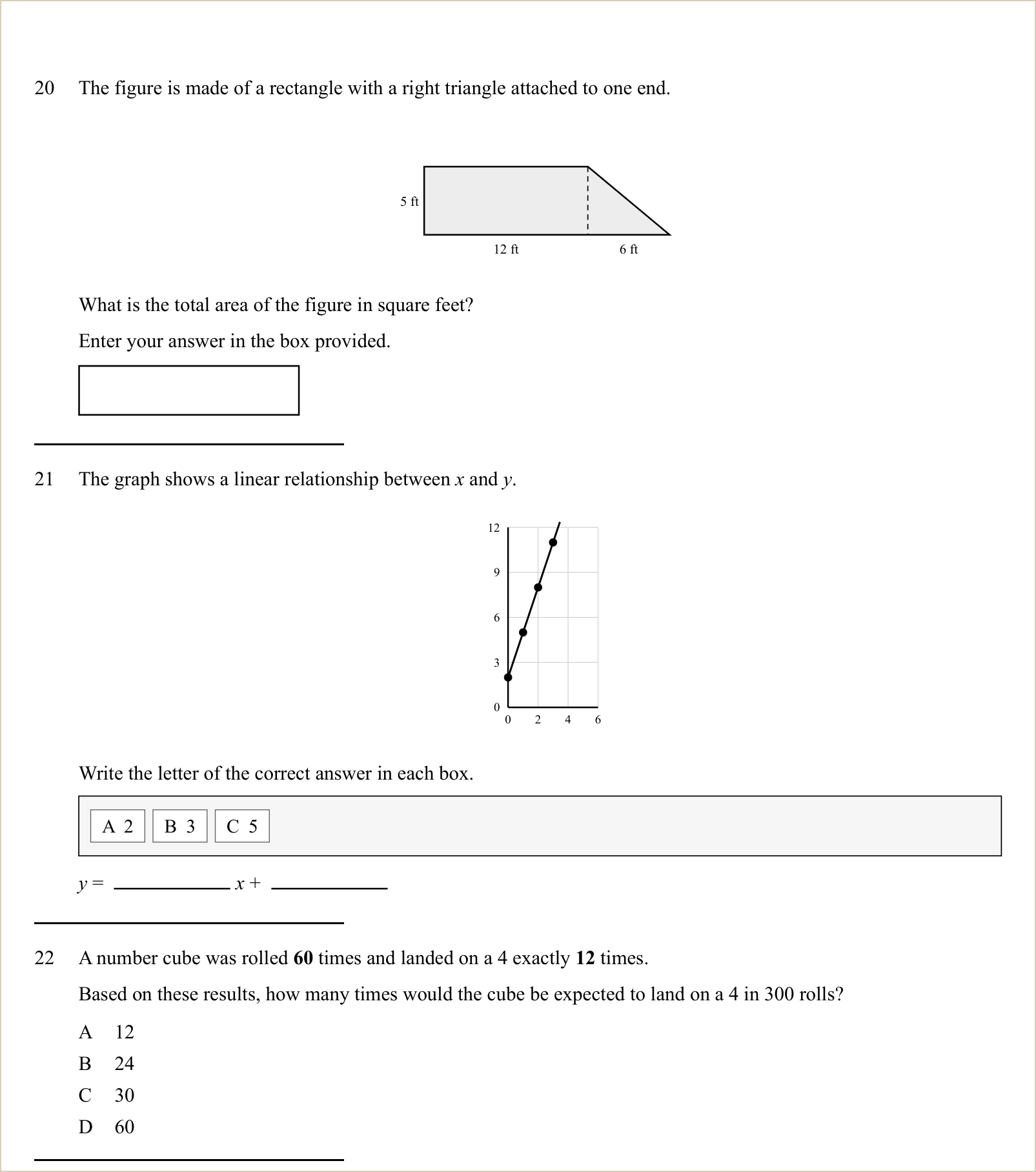
- Length: a real Grade 7 form is 38 questions worth 46 points — 30 questions worth one point and 8 worth two — and those numbers are fixed on every form.
- Question types: every one of the eight two-point questions is a question that is not multiple choice, and once the one-point questions of that kind are counted too, about four points in ten on this test come from something other than picking A, B, C, or D.
- Each practice test here: built to exactly that shape, so a practice sitting is the same length as test day and your child sees the same mix of question types the real test asks — not a worksheet of multiple choice with the hard parts left out.
Two things surprise families most about this test:
- Tools at Grade 7: there is still no calculator — Grade 7 is a no-calculator test, as Grade 6 was; a calculator arrives only at Grade 8, and every computation here, including the ones with π, is done by hand.
- Reference sheet: it grows — the circle arrives, with circumference and area and π, along with the volume of a pyramid, slope-intercept form, the distance formula, and simple and compound interest — but there is still no surface-area formula (Grade 7 finds surface area from a net, face by face) and no cylinder, cone, or sphere.
A student who has leaned on a calculator all year, or who expects the sheet to carry a formula it does not, needs to find that out here rather than on test day. This book is built for both.
What’s inside
- 5 complete 38-question practice tests (190 questions total), each worth 46 points exactly as a real form is
- Reporting categories weighted as on the official test: Computations and Algebraic Relationships carries 14 to 16 questions, the most of any category; Geometry and Measurement 11 to 13; Data Analysis and Personal Financial Literacy 5 to 7; and Probability and Numerical Representations 4 to 6 — and so does every test here
- Every question style on the real test, rendered for paper: multiple choice, drag-and-drop by writing letters in boxes, inline choice with lettered answer banks, hot spot printed as lettered choices, typed-number answers, and the number-line question where the solution of an inequality is drawn — with no bubble sheet, so students mark directly on the page as they will online
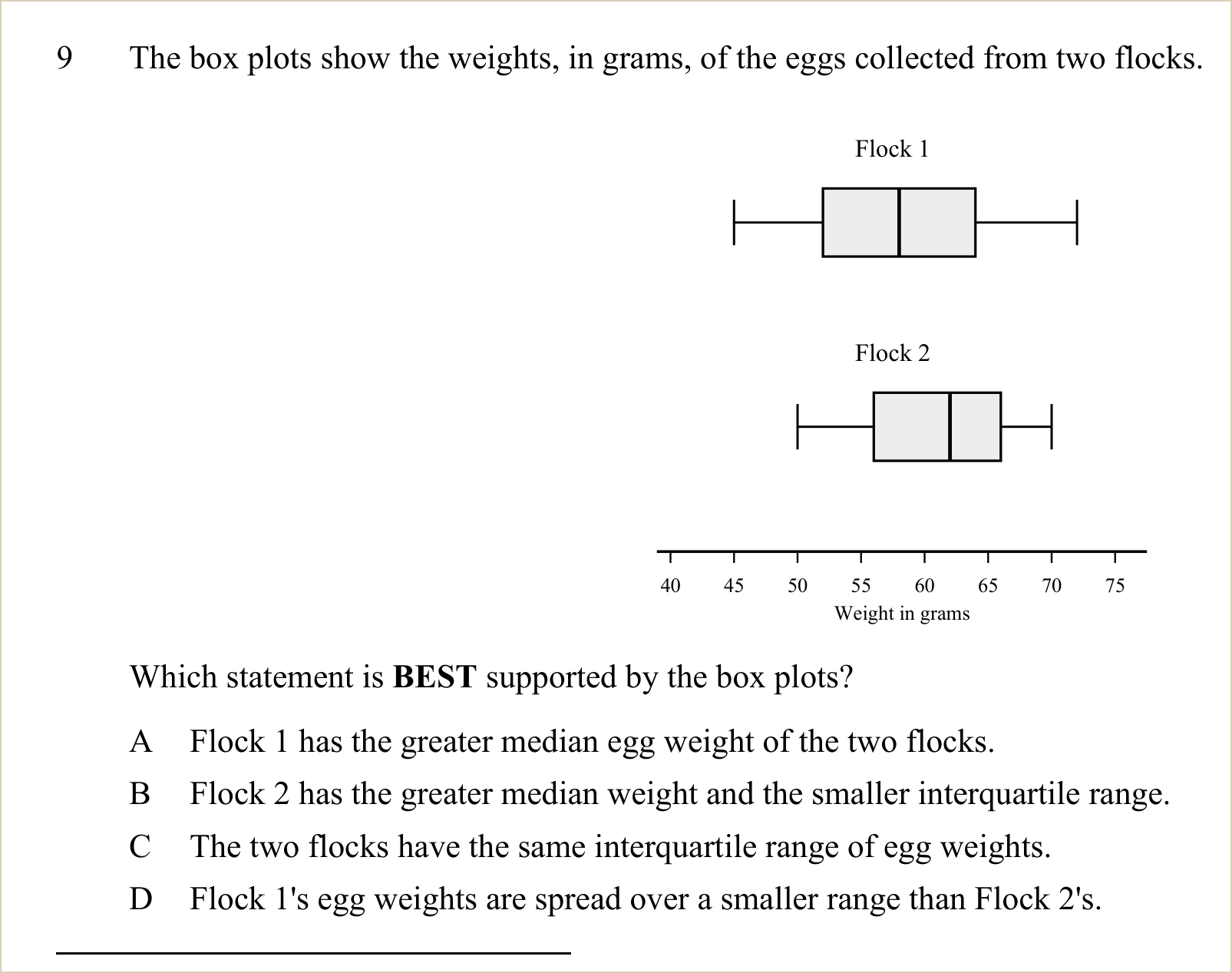
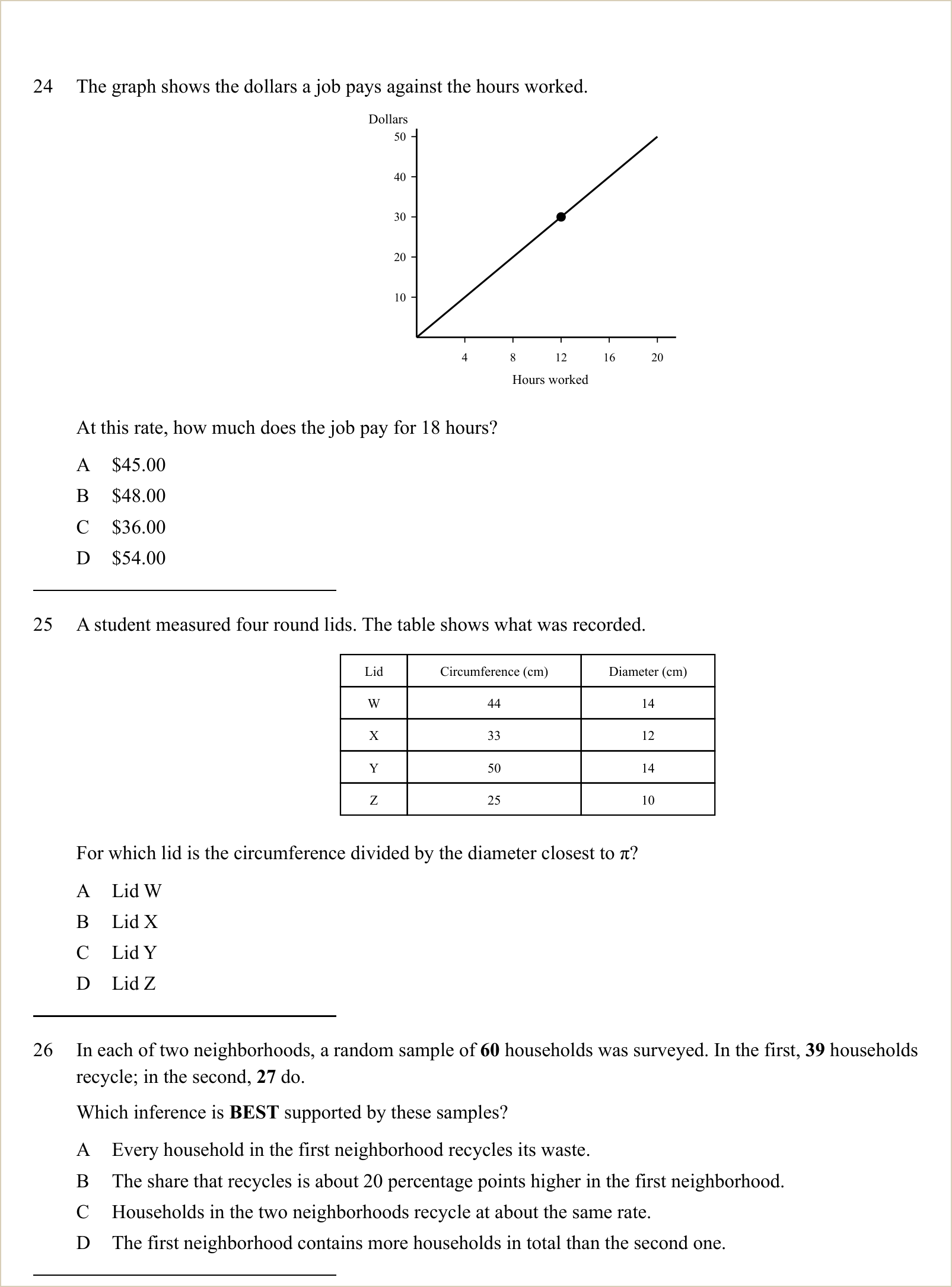
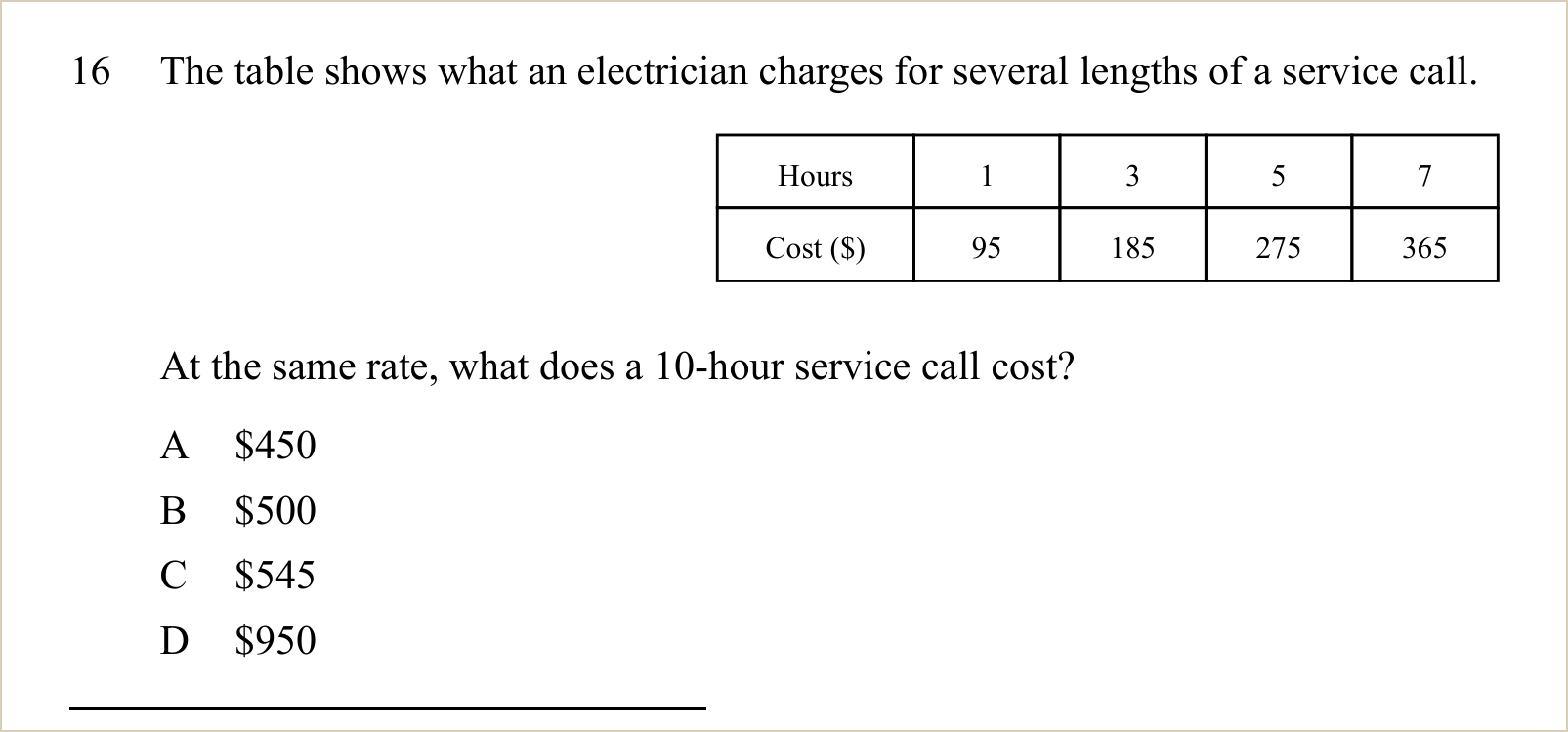
- Thirty-two drawn figures and seven data tables across the five tests — nets, circles, composite figures, angle diagrams, similar figures, scale drawings, dot plots, box plots, circle graphs, bar graphs, and number lines — every one checked against its own answer key
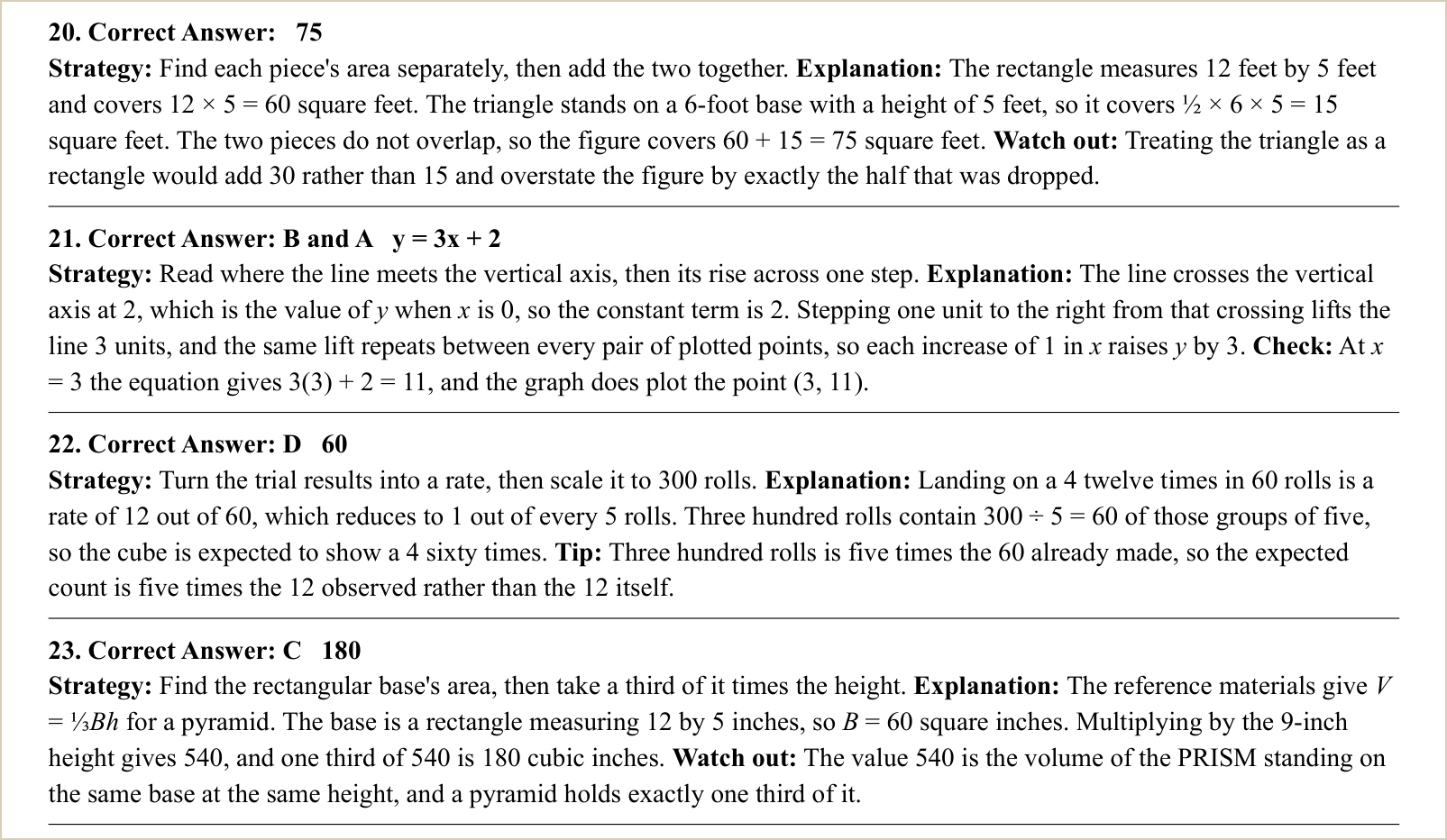
- Detailed answer explanations for every question — not just the correct letter, but step-by-step reasoning, and on every one a labeled note: a Tip naming the wrong answer a student is most likely to reach and how they got there, a Check that verifies the answer a second way, a Watch out for a trap in the wording, or the Big idea the question is really about
- A two-part Study Reference: the first page reproduces the real state reference sheet exactly as it is handed out, so your child practices with it rather than memorizing it; the pages after it are study material the test does not provide, and each says so plainly
- A parent letter on the test’s shape, the four reporting categories and their real weights, what each performance level means in Texas’s own words, and why the book does not print a “percent to pass”
- A quick-reference answer key for all five tests for fast scoring
Topics covered
- Adding, subtracting, multiplying, and dividing rational numbers, including negatives, fractions, and decimals
- Unit rates, including rates made of fractions, and constant rates extended to new values
- Percent increase and decrease, tax, tip, markup, and discount
- Proportional relationships — the constant of proportionality from a table, a graph, or an equation — and telling them apart from linear relationships that are not proportional
- Writing, using, and interpreting y = mx + b from a table, a graph, or a situation
- Writing and solving two-step equations and inequalities, including the sign flip when dividing by a negative, and graphing a solution on a number line
- Circumference and area of a circle, and the relationship between a circle’s circumference and its diameter
- Area of composite figures, including a figure with a piece removed
- Volume of prisms and pyramids, the one-third relationship between them, and surface area from a net
- Similar figures, scale drawings, and the map scale used to find a distance
- Angle relationships — the angles of a triangle, supplementary, complementary, and vertical angles — used to write and solve equations
- Converting between measurement systems
- Theoretical and experimental probability, predictions from a probability, compound events with and without replacement, and choosing a simulation that models a stated chance
- Comparing two groups from dot plots and box plots, and reading circle graphs and bar graphs to solve problems
- Personal financial literacy — sales tax, simple and compound interest, budgets, net worth, and the cost of a purchase over time
Why parents and teachers choose Smart Stars
- Written by experienced educators who study Texas’s official blueprint, released test forms, and scoring rationales
- Every question mirrors what students will see on test day — no surprises in format, content, or rigor
- Explanations teach the “why,” not just the “what,” so students learn from every mistake
- Item types, numbers, and contexts varied across the five tests — just like a real exam, every question feels fresh
- Built to the real point structure, including the eight two-point non-multiple-choice questions on every form — the feature students most often meet for the first time on test day