About this book
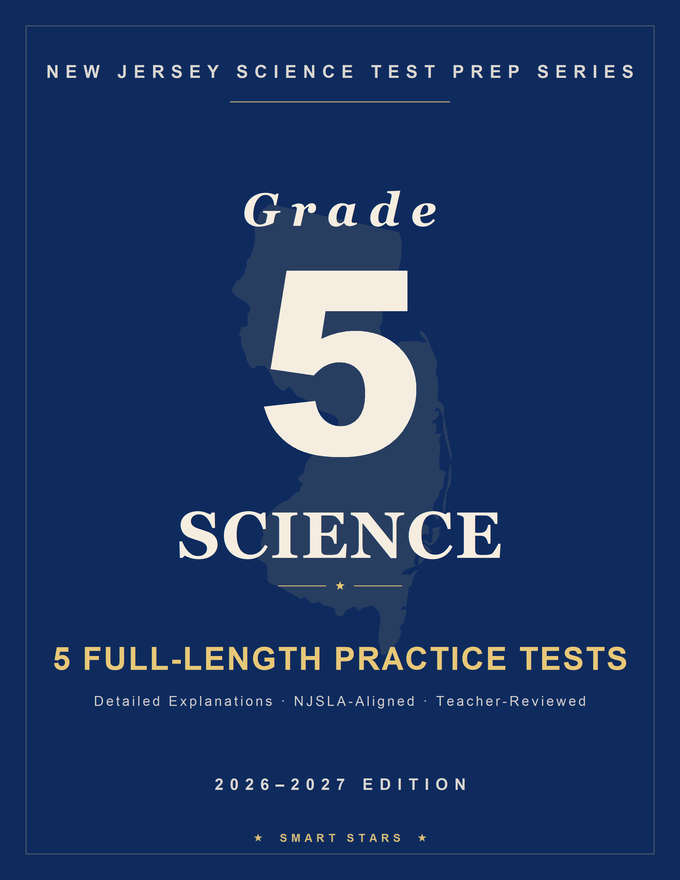
Give your fifth grader the confidence to succeed on the New Jersey Student Learning Assessment–Science (NJSLA–S) Grade 5 test.
This book contains five full-length practice tests — 260 questions total — aligned to the New Jersey Student Learning Standards for Science and designed to match the format, difficulty, and content of the real Grade 5 NJSLA–S. One thing about this test surprises New Jersey families more than anything else: the Grade 5 science test is not a test of Grade 5 science.
- Format: New Jersey tests science once in each grade band, so the Grade 5 test covers the standards for grades 3, 4 and 5 together — 45 performance expectations, of which only 13 are grade 5’s own.
- Each practice test here: every test draws its questions from all three years the way a real form does.
A student who reviews only this year’s science has prepared for about a third of the test.
On test day: the NJSLA–S is given in three units of 45 minutes each, and a four-function calculator is permitted.
What’s inside
- 5 complete 52-question practice tests worth 60 points each (260 questions total) — the same length, unit structure, and point total as a real NJSLA–S form
- Built the way the NJSLA–S is actually built — three timed units per test, each made of scenarios: a short observation about something happening in the world, then a table or a figure, then two to six questions about it. There are no stand-alone questions
- Every unit ends with its largest scenario, whose last question is a written response worth 3 or 4 points, with a sample response and point-by-point rubric for every one
- The full range of NJSLA–S question types, printed on paper so nothing on test day is unfamiliar: multiple choice, complete-the-sentence with two answer boxes, select two, match each row of a table, put the steps in order, short typed answers, and written responses — every one scored the way New Jersey scores it, one point all or nothing except the written responses
- Built to the six categories on the state’s own score report: the three science domains — Earth and Space, Life, and Physical Sciences — in the proportions of New Jersey’s published form, and the three science practices reported beside them — Investigating, Sensemaking, and Critiquing
- Every scenario set in New Jersey, as the state asks of its own item writers — Cape May’s horseshoe crabs, Barnegat Bay’s eelgrass, the Pine Barrens, the Highlands, Round Valley Reservoir, Sandy Hook, the Delaware, and more
- Detailed answer explanations for every question — not just the correct letter, but the reasoning from the table or figure, each closing with a Tip, Check, Method, Big idea, or Watch out
- Item types, contexts, and question positions varied across all 5 tests, so students never see the same problem twice in the same slot
- A parent letter that explains the four-unit test day (three scored units plus one unscored field-test unit that looks exactly like the others), the four numbered performance levels and the 100–300 scale, and what the six reporting categories mean
- A Grade 5 Science Study Reference for use before test day, organized by domain and practice and marked with the grade each idea comes from — New Jersey gives a Grade 5 student no reference sheet and no periodic table during the test, and the book says so plainly rather than implying one will be there
- 73 clean black-and-white drawings and 90 data tables — food webs, life cycles, wave diagrams, bar graphs, maps, and cross-sections, every one labeled
- A quick-reference answer key for all five tests for fast scoring
Topics covered
- Water on Earth and where it sits, reservoirs and aquifers, and why fresh water is scarce
- Weather against climate, and which kind of record answers which question
- The day-and-night sky, shadows through the year, and why stars look bright or dim
- Weathering, erosion, and deposition, and fossils as evidence of past environments
- Natural hazards — river ice jams, snowstorms, slumping road cuts — and evaluating whether a plan actually reduces harm
- How communities use and protect natural resources, from rain gardens to solar panels
- Body structures plants and animals use to survive, and how animals sense, process, and respond
- Life cycles, inherited traits, and traits shaped by the environment
- Groups that help their members survive, and habitats that meet an animal’s needs
- Food webs, decomposers, and the evidence that a plant’s material comes from air and water, not soil
- Balanced and unbalanced forces, gravity, magnets, and static electricity
- Speed and energy, collisions, and energy carried by light, sound, heat, and electric current
- Waves, amplitude and wavelength, and how we see
- Matter made of particles too small to see, identifying materials by their properties, and evidence that a new substance has formed
- Fair tests, testable questions, models, patterns in data, and claims supported by evidence
Why parents and teachers choose Smart Stars
- Written by experienced educators who study New Jersey’s official NJSLA–S technical reports, performance level descriptors, and released practice tests
- Every question mirrors what students will see on test day — no surprises in format, content, or rigor
- Explanations teach the “why,” not just the “what,” so students learn from every mistake
- Item types and contexts varied across the five tests — just like a real exam, every question feels fresh
- Built to the real three-unit, scenario-based architecture, across the whole grade 3–5 band the test assesses — the feature families most often discover for the first time on test day