About this book
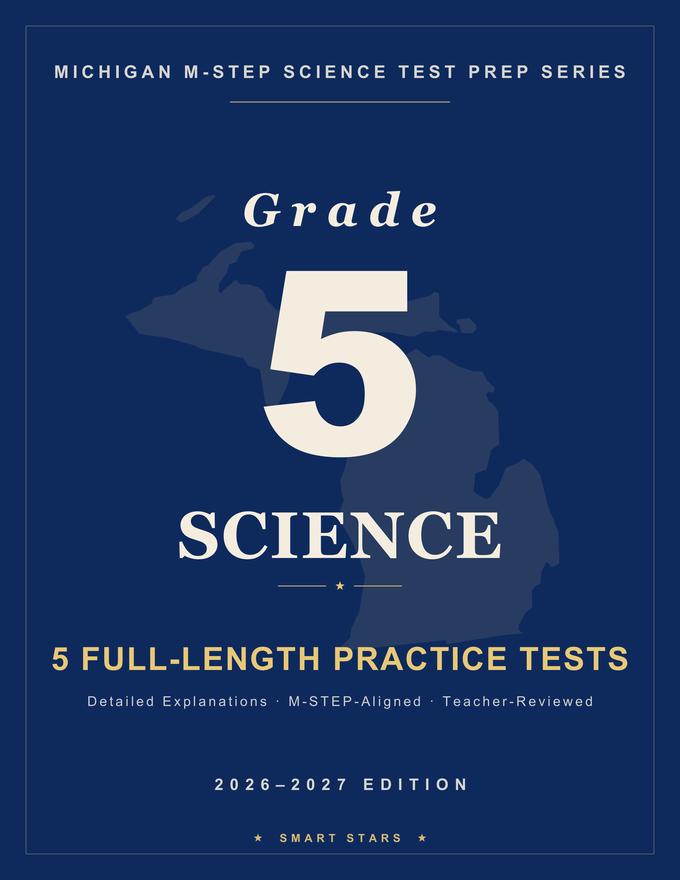
Give your fifth grader the confidence to succeed on the Michigan Student Test of Educational Progress (M-STEP) Science assessment.
This book contains five full-length practice tests — 220 questions total — aligned to the Michigan K–12 Science Standards for Grade 5.
- Format: a real M-STEP Science form is built from seven item clusters.
- Field-test items: one of the seven is a field-test cluster — questions tried out for future tests that look exactly like the rest but do not count toward your child’s score. That is why a real form numbers its questions to 44 while Michigan scores only 42 to 44.
- Each practice test here: the same 44 questions across six clusters, so a practice sitting is the same length as test day — and all 44 are scored-style items with full explanations.
So no practice time goes to questions that would not have counted.
What’s inside
- 5 complete 44-question practice tests (220 questions total)
- Built from item clusters, as M-STEP Science is — each opens with a real-world phenomenon (a passage, table, graph, or diagram) and asks a group of questions about it
- A cluster’s information arrives in two parts, as on the real test, so new data appears partway through and later questions depend on it — the biggest difference from an ordinary worksheet
- Every question worth one point; on a multi-part question all parts must be correct — scored the way Michigan scores it
- Detailed explanations for every question — not just the correct letter, but step-by-step reasoning
- Reporting categories as on the official test — Physical Science, Life Science, Earth and Space Science — and every answer labeled with its standard, category, and skill
- Item types, names, and contexts varied across all 5 tests, so no problem repeats in the same slot
- A parent letter with test-taking tips, plus a Grade 5 Science Study Reference — Michigan gives no reference sheet during the grade 5 science test, and the book says so
- A quick-reference answer key for all five tests
On test day: M-STEP Science is untimed and student-paced, and a four-function calculator is available, though most questions do not call for one.
Topics covered
- Balanced and unbalanced forces, patterns in motion, and forces that act at a distance
- Energy transfer, energy stored in food, and energy released by decomposers
- Waves carrying energy rather than matter; light, reflection, and visibility
- Particle models of matter, conservation of matter, and evidence a new substance has formed
- Plants building their material from air and water; food webs, decomposers, and matter moving through an ecosystem
- Habitats, inherited traits, variation among offspring, and traits shaped by the environment
- Animal structures and functions, and group behavior as a survival advantage
- Earth’s water distribution, weather, climate, and the processes that shape Earth’s surface
- Earth’s systems interacting; fossils and rock layers; the sun, stars, and sky patterns
- Natural hazards, and evaluating whether a design solution actually reduces harm
Why parents and teachers choose Smart Stars
- Written by educators who study Michigan’s official M-STEP specifications, performance level descriptors, and released item samplers
- Every question mirrors what students will see on test day — no surprises in format, content, or rigor
- Explanations teach the “why,” not just the “what,” so students learn from every mistake
- Built to the real cluster architecture, including the two-part stimulus — the feature students most often meet for the first time on test day