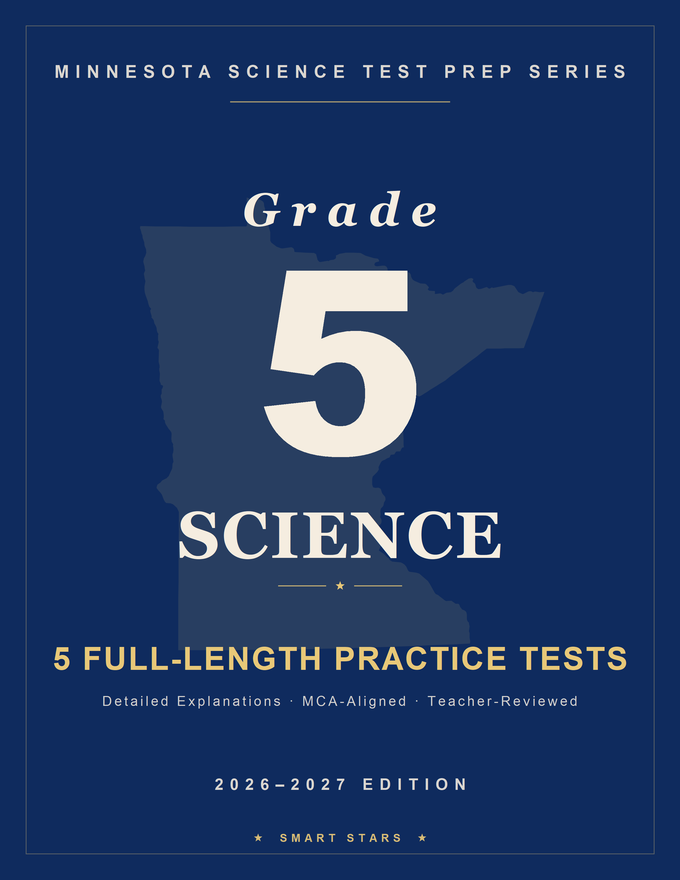
Give your fifth grader the confidence to succeed on the Science Minnesota Comprehensive Assessment, Series IV (Science MCA-IV).
This book contains five full-length practice tests — 205 questions total — aligned to the 2019 Minnesota Academic Standards in Science. It is built around the fact that surprises Minnesota families most: the Grade 5 science test is not Grade 5 science alone. Minnesota tests science once in elementary school, so the form draws on the grade 3, 4 and 5 standards together — 38 benchmarks, of which only 16 belong to Grade 5 — and every benchmark has an equal chance of appearing, so no year is safe to skip. A real form carries 39 to 43 scored questions worth 45 points; each test here runs 41 worth the same 45.
What’s inside
- 5 complete 41-question practice tests (205 questions total), each worth 45 points as on the real form
- Every question inside a phenomenon group, as Science MCA-IV is built — one observed event across Tab A, Tab B and sometimes Tab C, each question naming its tab
- Six groups per test, two per reporting category, in a different order every test; points in exact thirds — 15 each for Earth and Space, Life, and Physical Science
- All four Minnesota question types, including the paper form’s fill-in types
- Detailed explanations for every question — step-by-step reasoning, not just the correct letter — plus a sample 3-point answer and rubric for every constructed response
- Every answer labeled with its benchmark, reporting category, the standard’s grade, and the skill in plain words
- Names, contexts and numbers varied across all 5 tests, so no question repeats in the same slot
- A parent letter with tips, and a Grade 5 Science Study Reference covering all three years — the real test gives no reference sheet or periodic table, and the book says so
- A quick-reference answer key for all five tests
Topics covered
- Daylight, shadows and star patterns through the year, and how Minnesota American Indian Tribes and other cultures have used them to mark the seasons
- Weathering and erosion, fair tests of ways to slow it, rock layers and fossils, and where Earth’s water is
- Earth’s interacting systems, the water cycle, natural hazards, and renewable and nonrenewable resources
- Structures plants and animals use to survive, life cycles, habitats and survival strategies
- Inherited traits, variation within a group, and traits shaped by the environment
- Plants building themselves from air and water, matter and food energy in an ecosystem, and species added or removed
- How we see, light reflection, waves absorbed by materials, and forces acting at a distance
- The particle model of matter, conservation of matter, evidence of a new substance, and identifying materials by properties
- Energy as sound, light, heat and electric current; speed, collisions, and energy-converting devices
Why parents and teachers choose Smart Stars
- Written by educators who study Minnesota’s official Science MCA-IV specifications, performance level descriptors, and released forms
- Every question mirrors what students will see on test day — no surprises in format, content, or rigor
- Explanations teach the “why,” not just the “what,” so students learn from every mistake
- Built to the real phenomenon-group architecture, including the tabbed Phenomena Book — the feature students most often meet first on test day
How to use this book
Take one test at a time in a quiet space. Science MCA-IV is not strictly timed and most students finish in about one and a half to two hours, so let your child do a whole test in one or two calm sittings. A basic calculator and a ruler are allowed; there is no formula sheet and no periodic table. Score with the quick answer key, then review every explanation, even for correct answers. Space the five tests over several weeks.