About this book
Give your sixth grader the confidence to succeed on the State of Texas Assessments of Academic Readiness (STAAR) Grade 6 Mathematics test.
This book contains five full-length practice tests — 180 questions total — aligned to the Texas Essential Knowledge and Skills for Grade 6 Mathematics and designed to match the format, difficulty, and content of the real STAAR exam.
Take a look inside
- Length: a real Grade 6 form is 36 questions worth 43 points — 29 questions worth one point and 7 worth two — and those numbers are fixed on every form.
- Question types: every one of the seven two-point questions is a question that is not multiple choice, and once the one-point questions of that kind are counted too, about four points in ten on this test come from something other than picking A, B, C, or D.
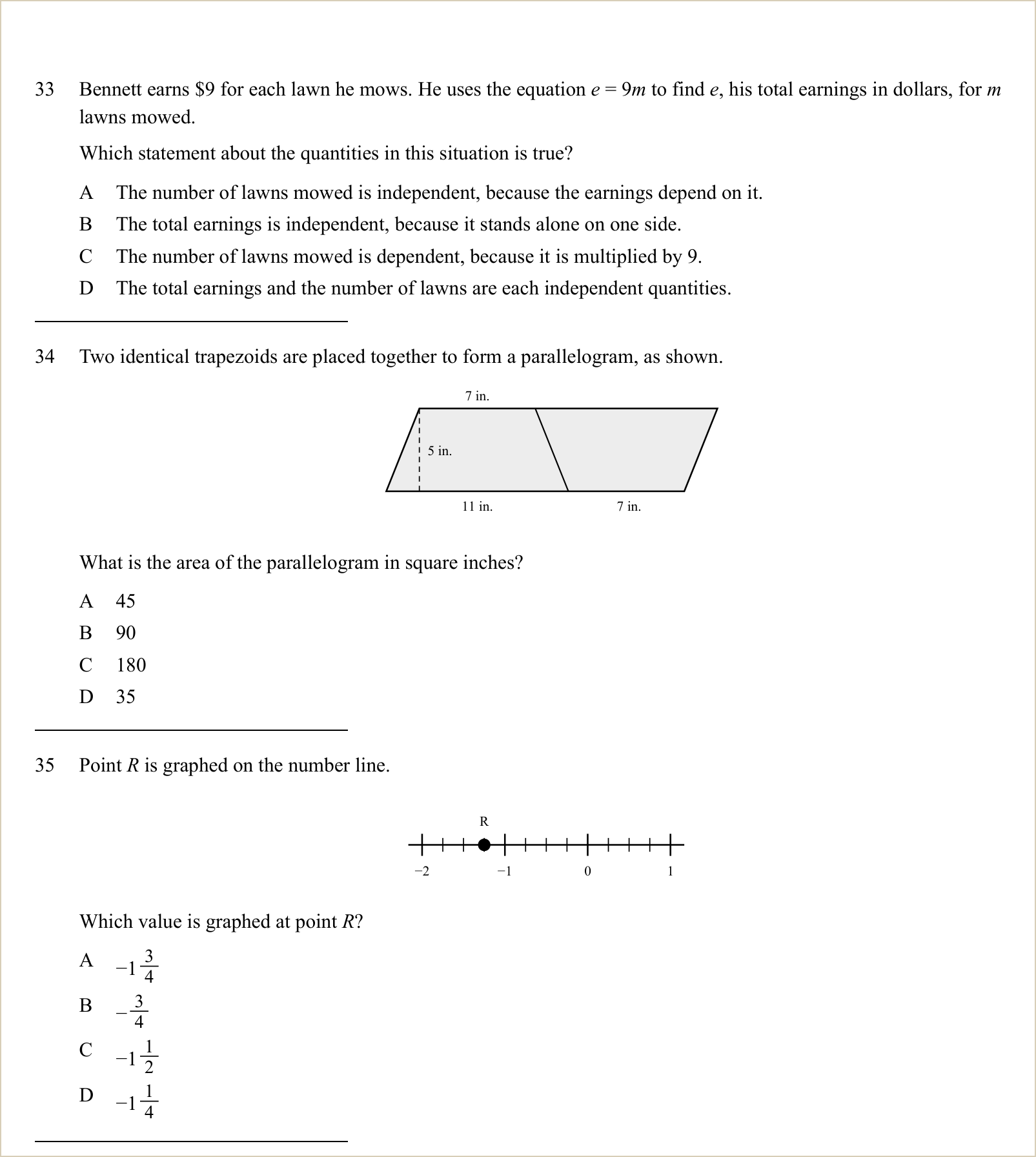
- Each practice test here: built to exactly that shape, so a practice sitting is the same length as test day and your child sees the same mix of question types the real test asks — not a worksheet of multiple choice with the hard parts left out.
Two things surprise families most about this test:
- Tools at Grade 6: there is no calculator — Grade 6 is a no-calculator test, and so is Grade 7; a calculator arrives only at Grade 8.
- Reference sheet: it is small — Texas hands every sixth grader a one-page sheet carrying exactly four formulas and a table of unit conversions, with no circumference, no area of a circle, and no π.
A student who has leaned on a calculator all year, or who expects the formula sheet to carry more than it does, needs to find that out here rather than on test day. This book is built for both.
What’s inside
- 5 complete 36-question practice tests (180 questions total), each worth 43 points exactly as a real form is
- Reporting categories weighted as on the official test: Computations and Algebraic Relationships carries 13 to 15 questions, the most of any category; Numerical Representations and Relationships 8 to 10; Data Analysis and Personal Financial Literacy 6 to 8; and Geometry and Measurement 5 to 7 — and so does every test here
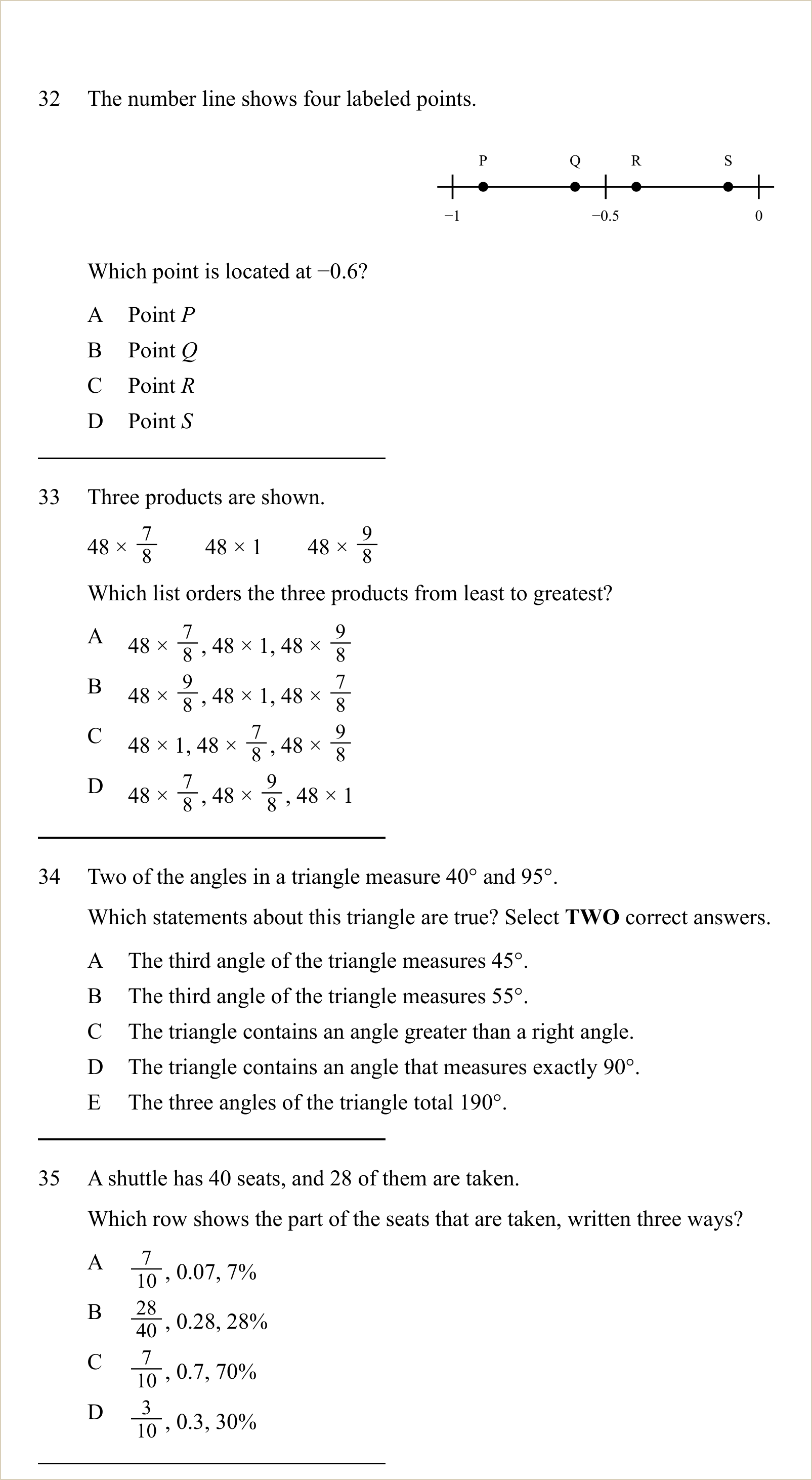
- Every question style on the real test, rendered for paper: multiple choice, drag-and-drop by writing letters in boxes, select-two, and match table grids — with no bubble sheet, so students mark directly on the page as they will online
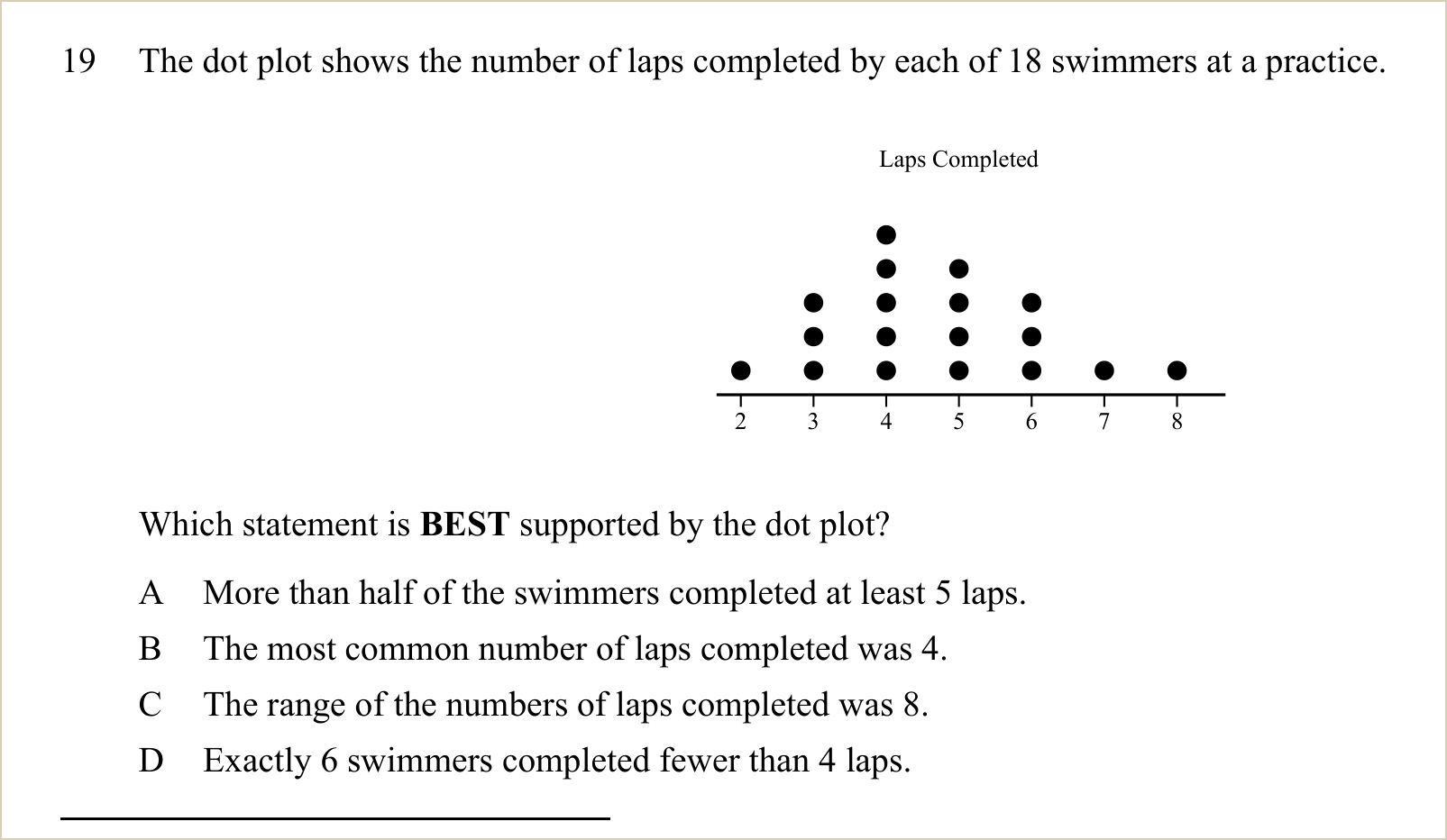
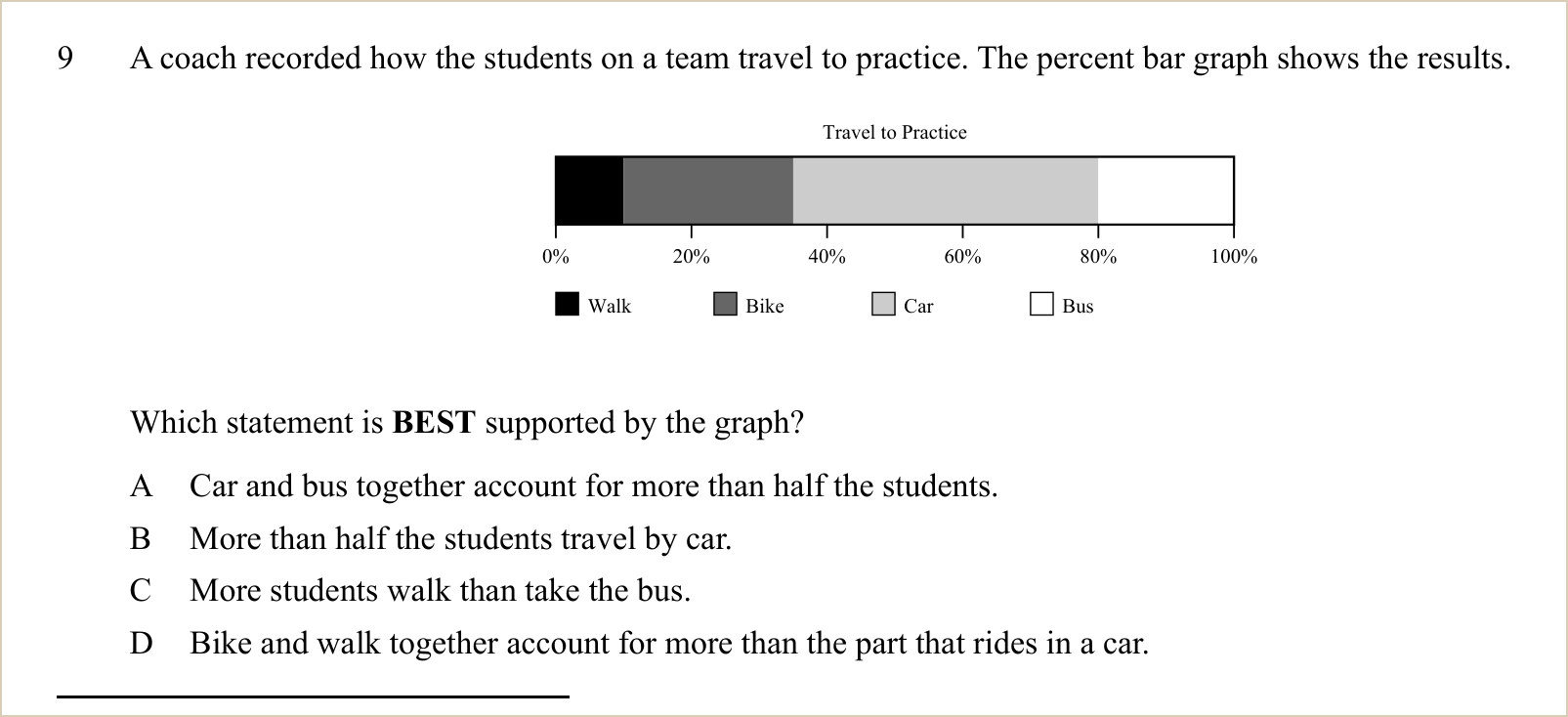
- Twenty-four drawn figures and twenty-six data tables across the five tests — number lines, coordinate planes, dot plots, histograms, box plots, bar graphs, geometric figures, and the tables and check registers the real test builds questions on — every one checked against its own answer key
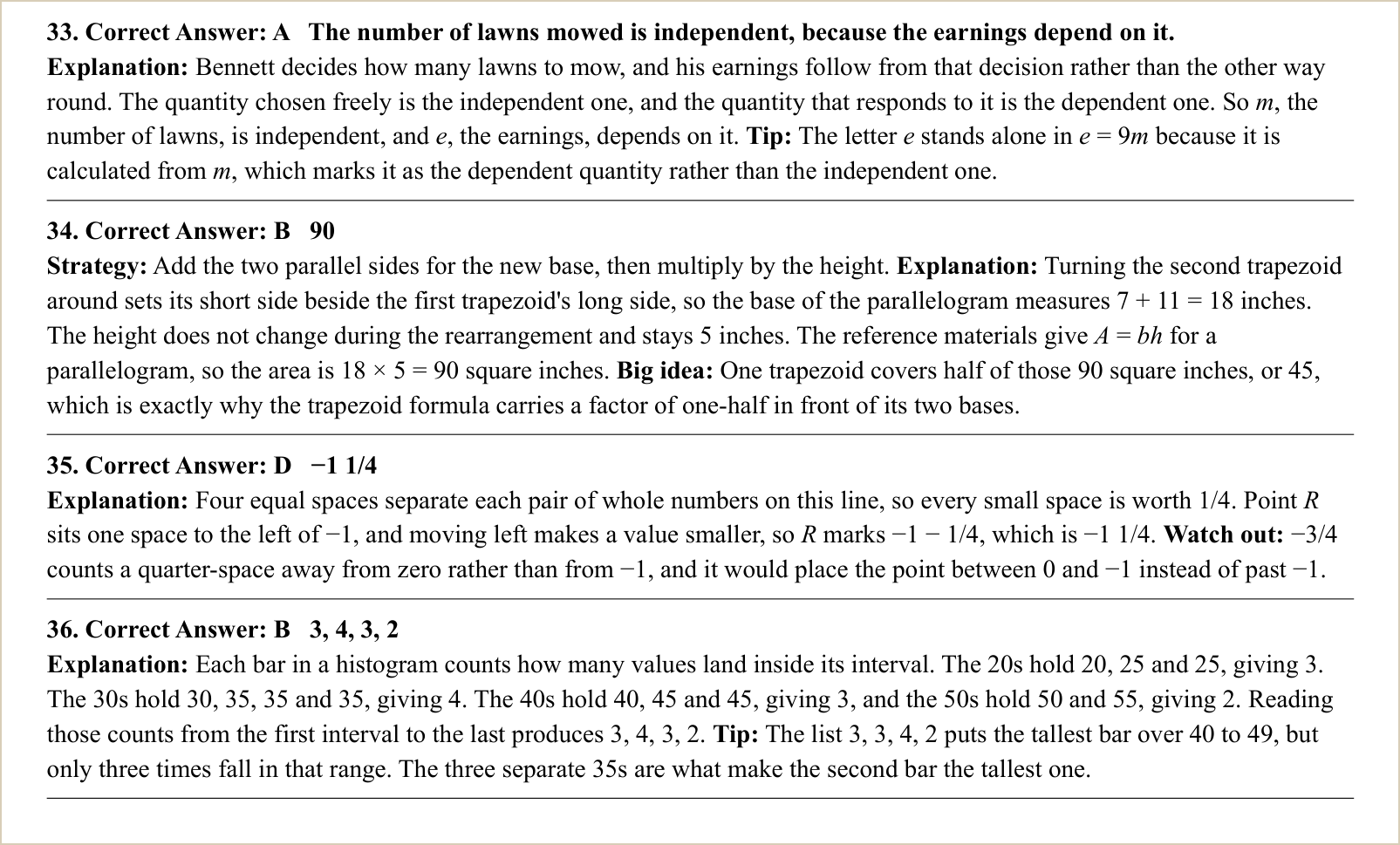
- Detailed answer explanations for every question — not just the correct letter, but step-by-step reasoning, and on every one a labeled note: a Tip naming the wrong answer a student is most likely to reach and how they got there, a Check that verifies the answer a second way, a Watch out for a trap in the wording, or the Big idea the question is really about
- A two-part Study Reference: the first page reproduces the real state reference sheet exactly as it is handed out, so your child practices with it rather than memorizing it; the pages after it are study material the test does not provide, and each says so plainly
- A parent letter on the test’s shape, the four reporting categories and their real weights, what each performance level means in Texas’s own words, and why the book does not print a “percent to pass”
- A quick-reference answer key for all five tests for fast scoring
Topics covered
- Integers, fractions, and decimals — adding, subtracting, multiplying, and dividing, including operations with negative numbers
- Rational numbers on the number line, absolute value, and ordering numbers written in different forms
- Converting between fractions, decimals, and percents, and recognizing equivalent forms
- Recognizing equivalent expressions, and evaluating an expression in the right order
- Ratios, rates, and unit rates used to solve problems
- Percents in context, including finding the whole from a part
- Writing and solving one-step equations and inequalities, and reading “at least” and “at most” into the right symbol
- Independent and dependent quantities, and telling an additive rule from a multiplicative one in a table, a graph, or an equation
- Area of triangles, parallelograms, and trapezoids, and volume of a rectangular prism, using the state reference sheet
- The angles of a triangle and which side lengths can form one
- Plotting and reading points in all four quadrants of the coordinate plane
- Converting units within a measurement system
- Dot plots, histograms, box plots, and percent bar graphs, and what each one can and cannot show
- Mean, median, and range
- Personal financial literacy — checking accounts and check registers, debit cards against credit cards, credit history, and comparing salaries and the education behind them
Why parents and teachers choose Smart Stars
- Written by experienced educators who study Texas’s official blueprint, released test forms, and scoring rationales
- Every question mirrors what students will see on test day — no surprises in format, content, or rigor
- Explanations teach the “why,” not just the “what,” so students learn from every mistake
- Item types, numbers, and contexts varied across the five tests — just like a real exam, every question feels fresh
- Built to the real point structure, including the seven two-point non-multiple-choice questions on every form — the feature students most often meet for the first time on test day