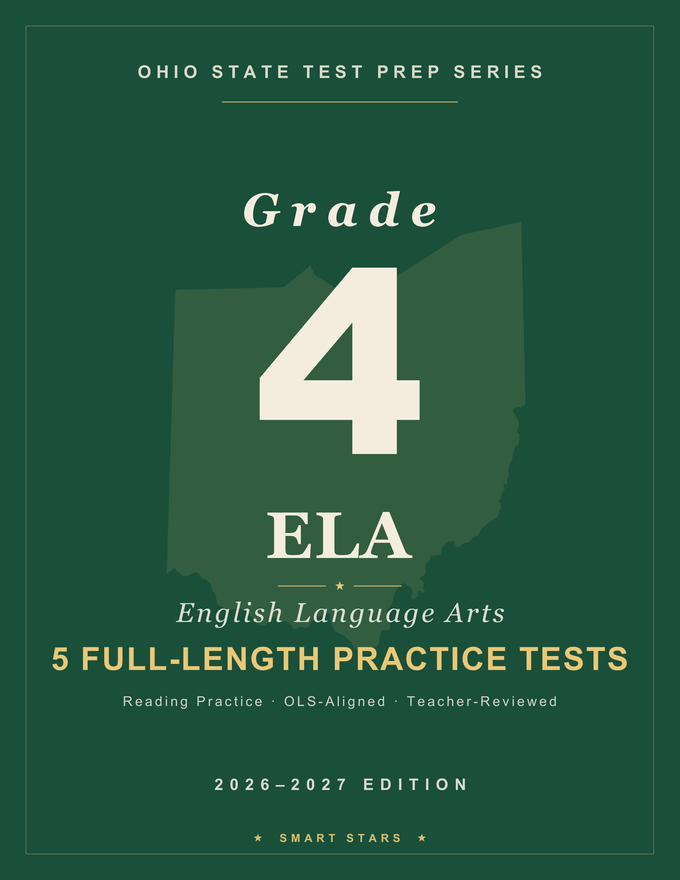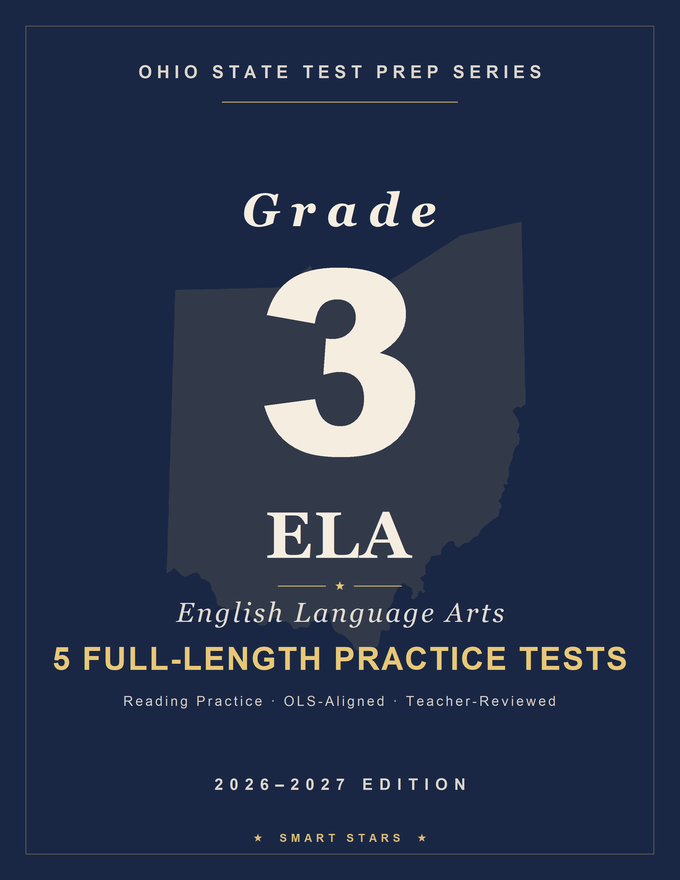
Give your third grader the confidence to succeed on Ohio's State Test (OST) in English Language Arts.
This book contains five full-length practice tests — 165 questions total — aligned to Ohio’s Learning Standards for Grade 3 English Language Arts and designed to match the format, difficulty, and reading level of the real Grade 3 OST exam. (A real OST form mixes a few unscored field-test questions in with the scored ones, and they are not marked in any way.
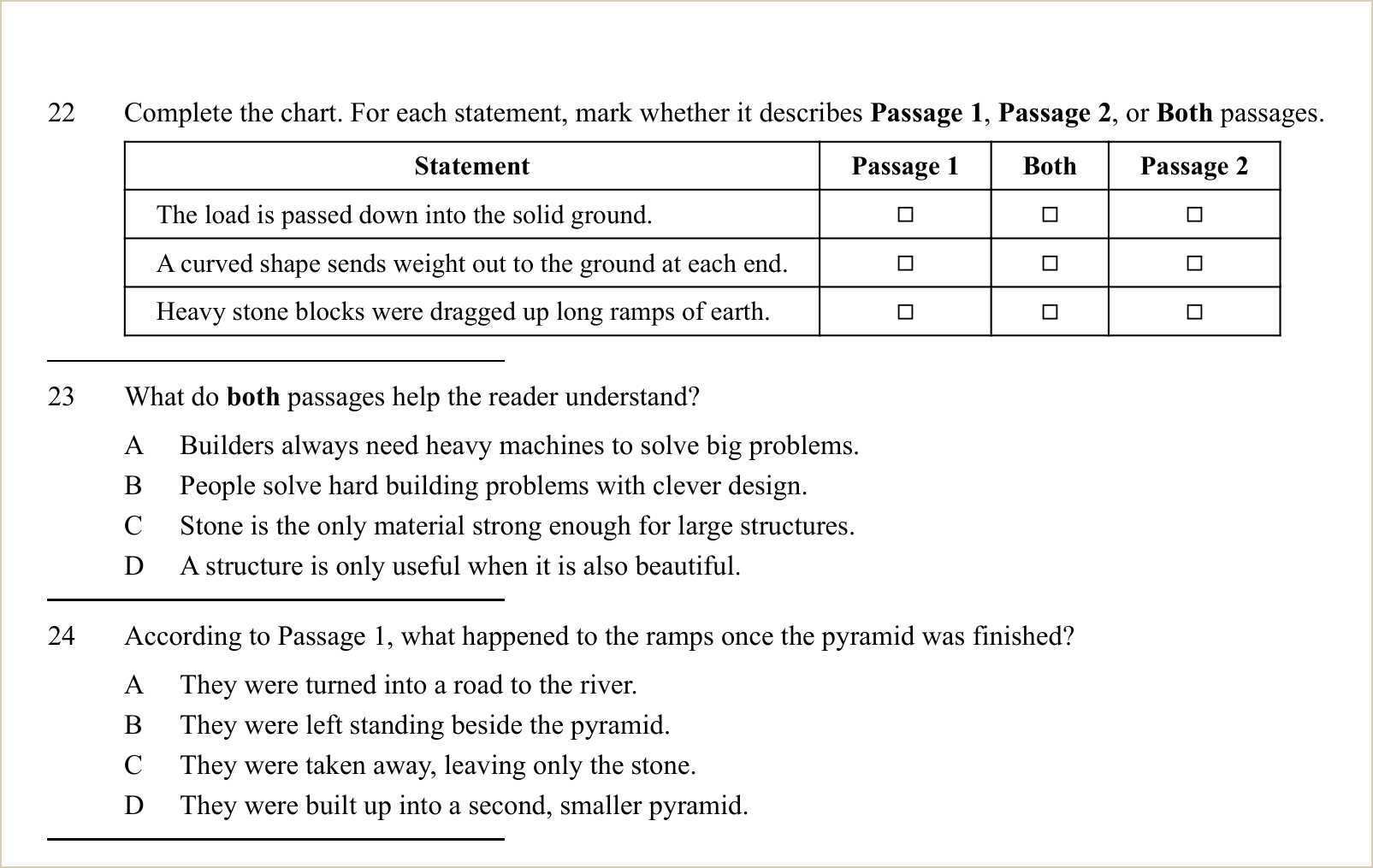
Take a look inside
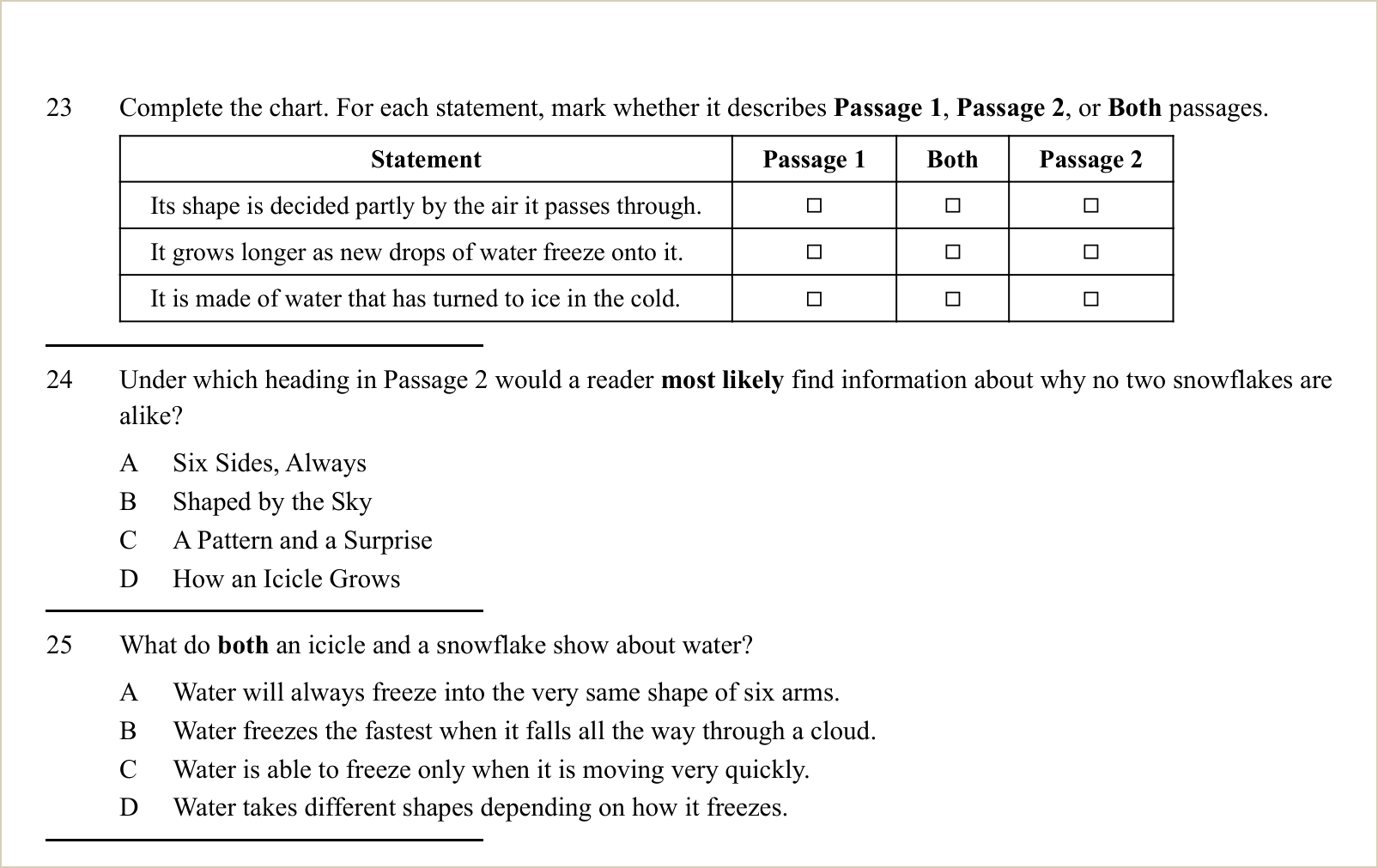
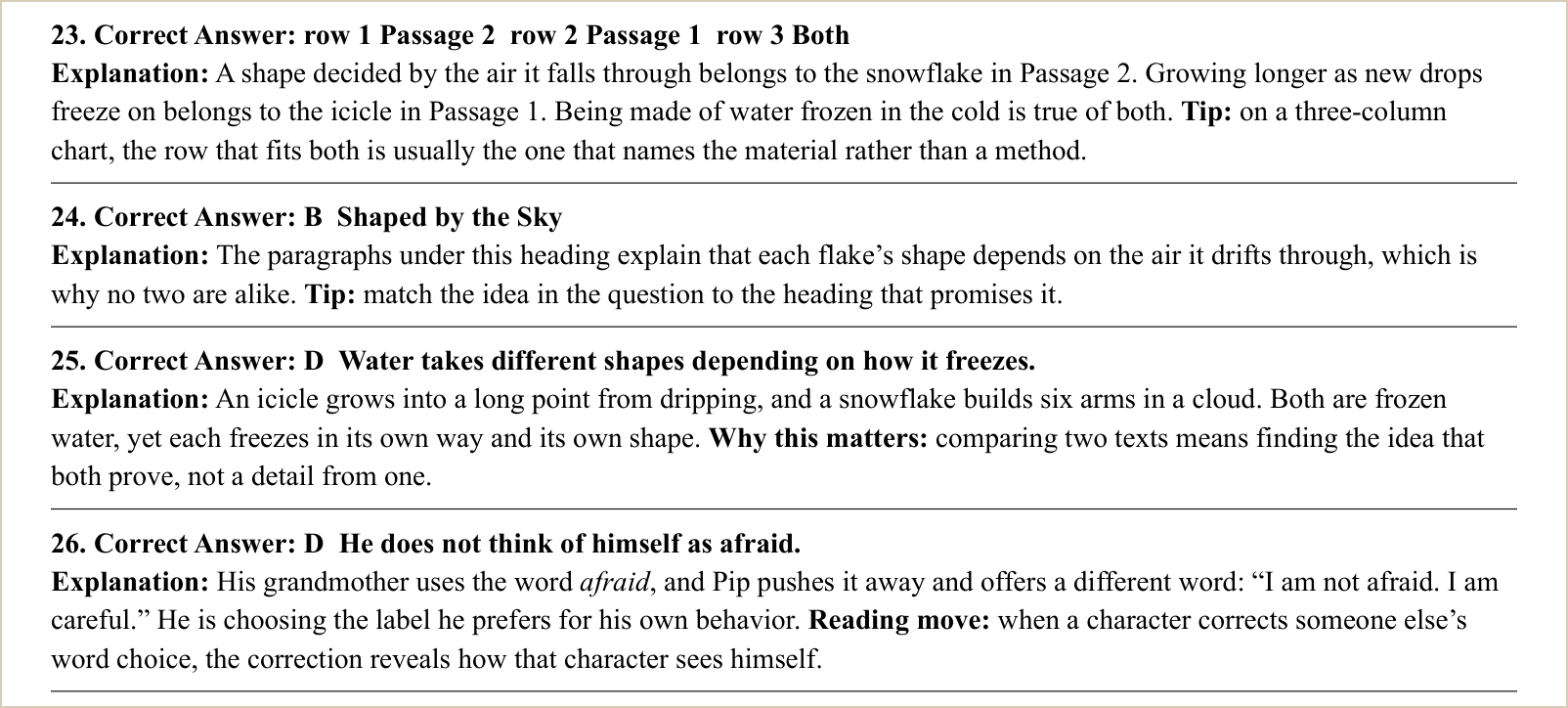
Each test in this book runs the same on-screen length — 33 questions worth 42 points — so a practice sitting is as long as test day and your child builds real-world test “endurance” for the full sitting, with the difference that every one of the 33 questions here comes with a full explanation, so no practice time is spent on a question that would not have counted.)
Grade 3 matters in Ohio: Under the Third Grade Reading Guarantee, a student’s grade 3 ELA result can affect promotion to fourth grade, and there are fall, spring, and summer chances to reach the promotion score. Five full-length practice sittings with worked answers are one way to make sure your child walks in ready.
On test day: Ohio gives the Grade 3 ELA test in two parts of about 90 minutes each, and the parts may be taken on different days.
What’s inside
- 5 complete 33-question practice tests (165 questions total), each built from original reading passages — stories, poems, informational articles, and paired-passage sets on the same topic or by the same author
- Every OST item format, rendered for paper: single-answer multiple choice, multiple select (with the count named, exactly like the real test), two-part evidence-based items where Part B asks for the sentence that proves Part A, and matching charts that sort statements between two passages
- One passage-based written response per test, with a full ruled response area and Ohio’s three-trait 10-point scoring guide printed right after each test’s explanations
- Detailed answer explanations for every question — not just the correct letter, but text-evidence reasoning that shows exactly where the answer comes from in the passage, plus a labeled reading move or tip your child can reuse on the next passage
- Reporting categories weighted as on the official test: Reading Literary Text and Reading Informational Text sharing the reading points about evenly, plus Writing
- Passages, topics, and question types varied across all 5 tests, so students never see the same setup twice in the same slot
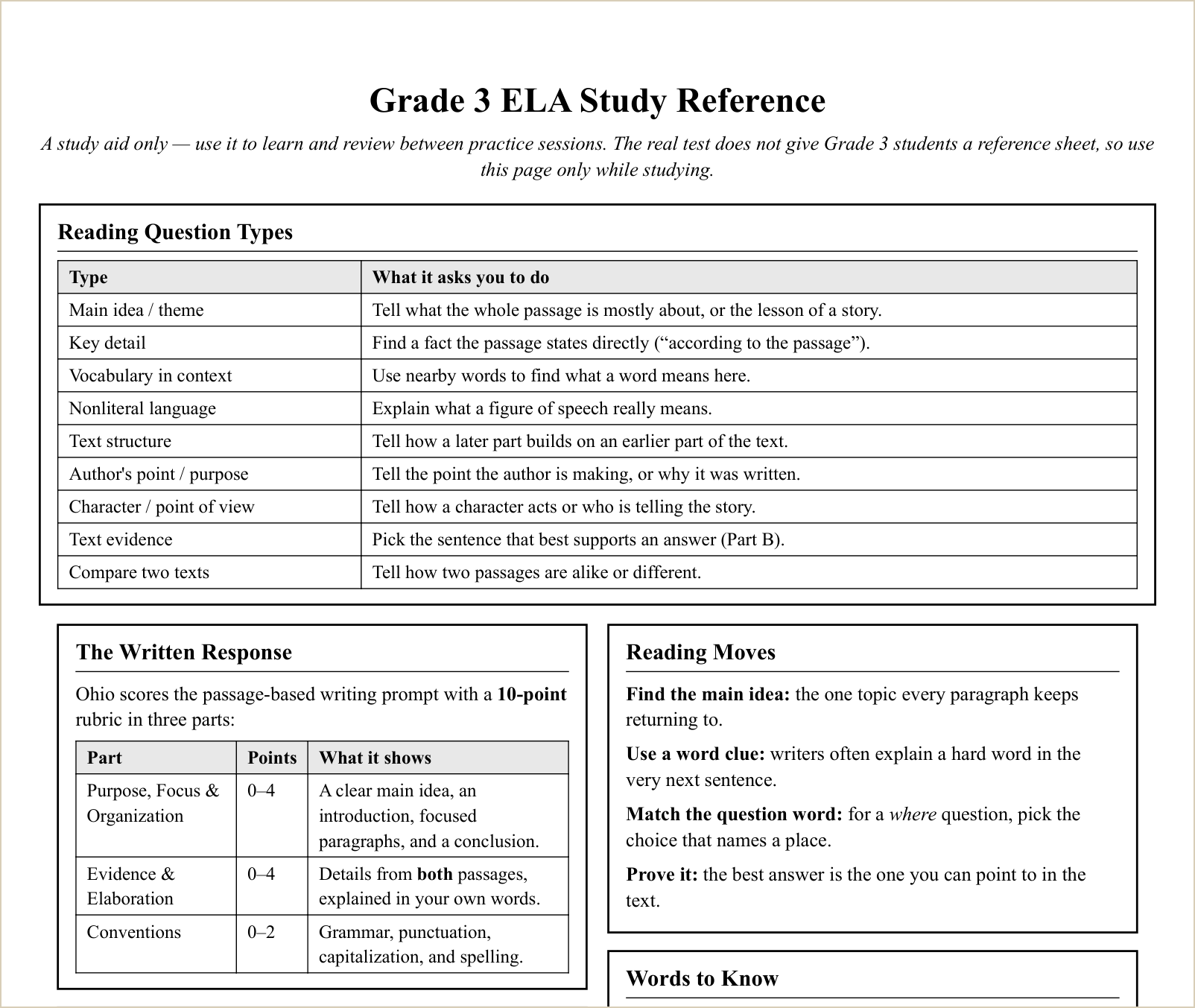
- A parent letter with test-taking tips and a plain explanation of the Third Grade Reading Guarantee, plus a Grade 3 ELA Study Reference — a question-type guide, reading moves, and the written-response rubric — for review between sessions
- A quick-reference answer key for all five tests for fast scoring
Skills covered
- Asking and answering questions with evidence from the text, including what a passage says explicitly and what it lets the reader infer
- Determining the main idea of an informational passage and the central message, lesson, or moral of a story, fable, or folktale
- Describing characters and explaining how their actions move a story forward
- Determining the meaning of words and phrases from context, including figurative and literal meanings
- Using text features and headings to locate information
- Distinguishing the reader’s point of view from the narrator’s or the author’s
- Explaining how the parts of a story, poem, or article build on one another — paragraphs, stanzas, and sections
- Comparing and contrasting two texts by the same author or on the same topic
- Explaining how an author uses reasons and evidence to support a point
- Producing an organized written response that states an idea and supports it with evidence from both passages
Why parents and teachers choose Smart Stars
- Written by experienced educators who study Ohio’s official OST specifications, blueprints, released practice tests, and the Third Grade Reading Guarantee guidance
- Every passage is original and every question mirrors what students will see on test day — no surprises in format, content, or rigor
- Explanations teach the “why,” pointing to the exact text evidence, so students learn from every mistake
- Passages and question types varied across the five tests — just like a real exam, every test feels fresh
- Answer letters and choice lengths balanced across the book, so there is no pattern to guess from — only the reading counts